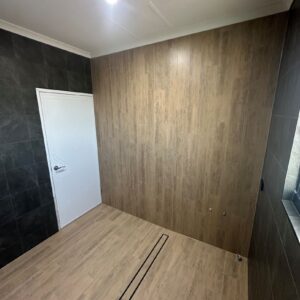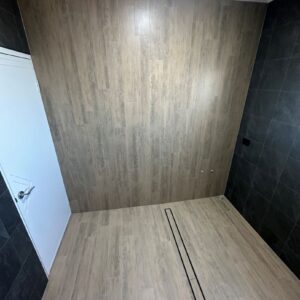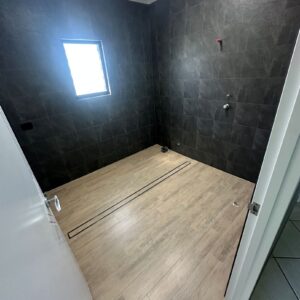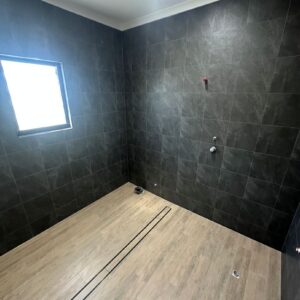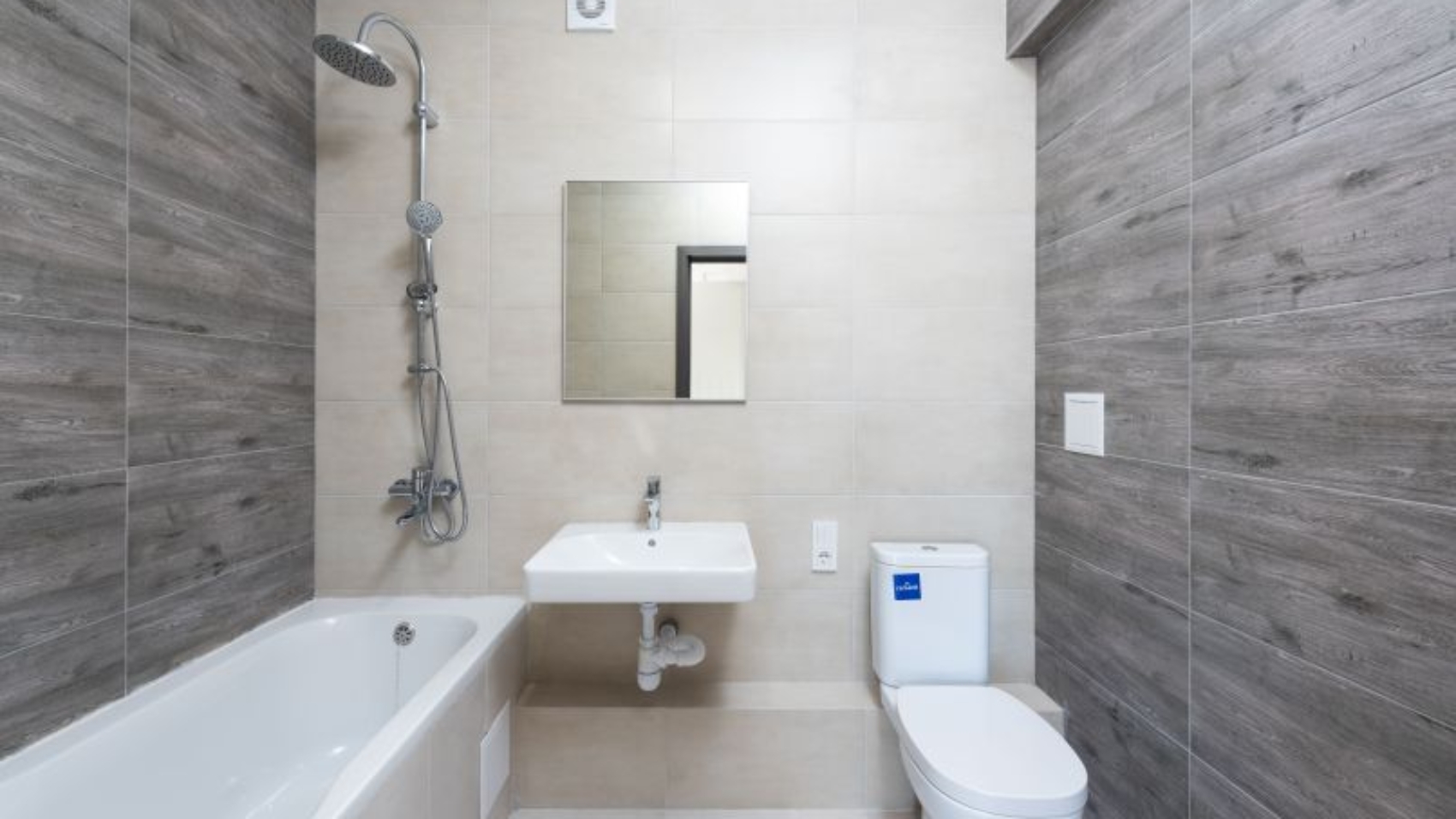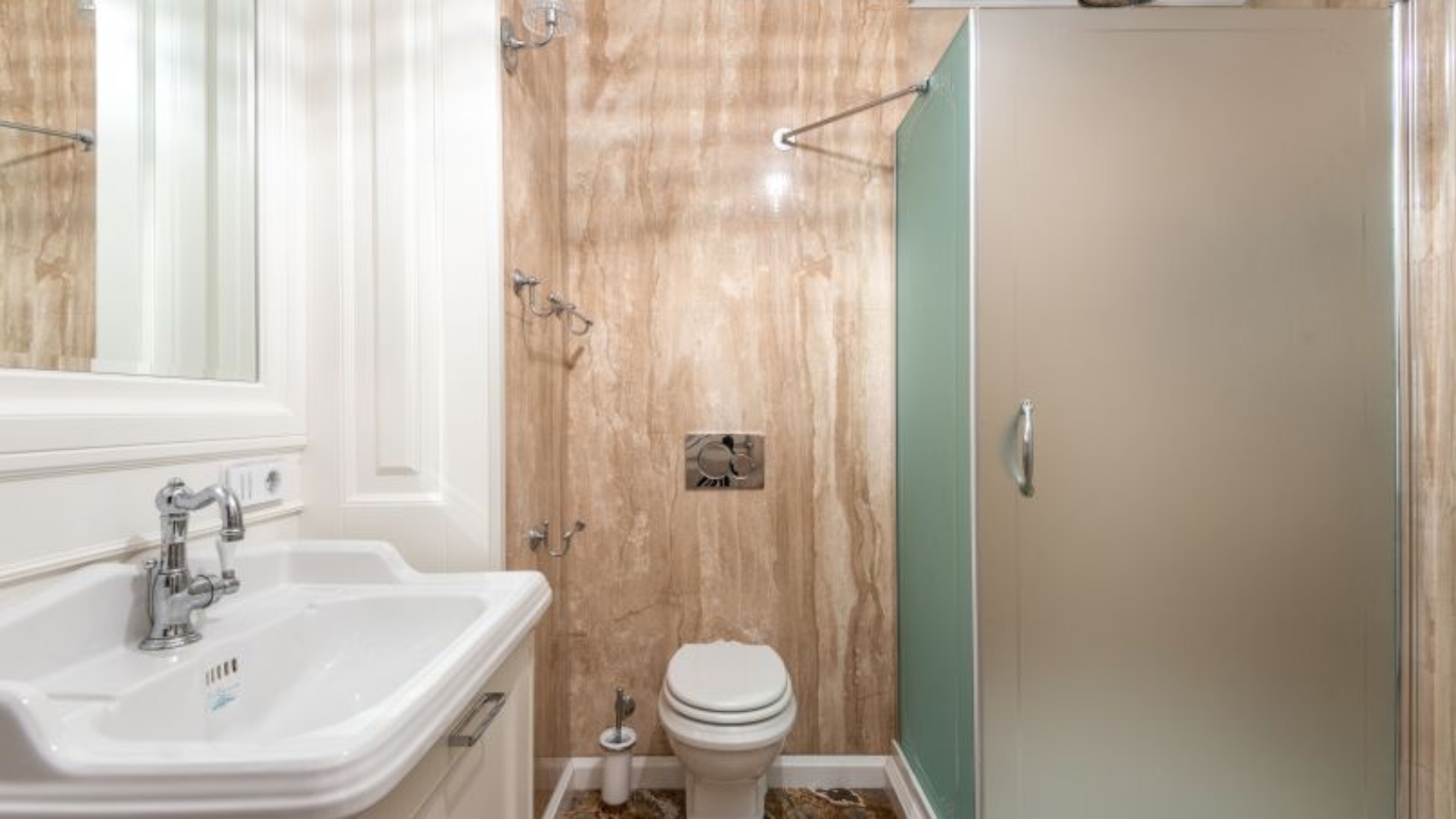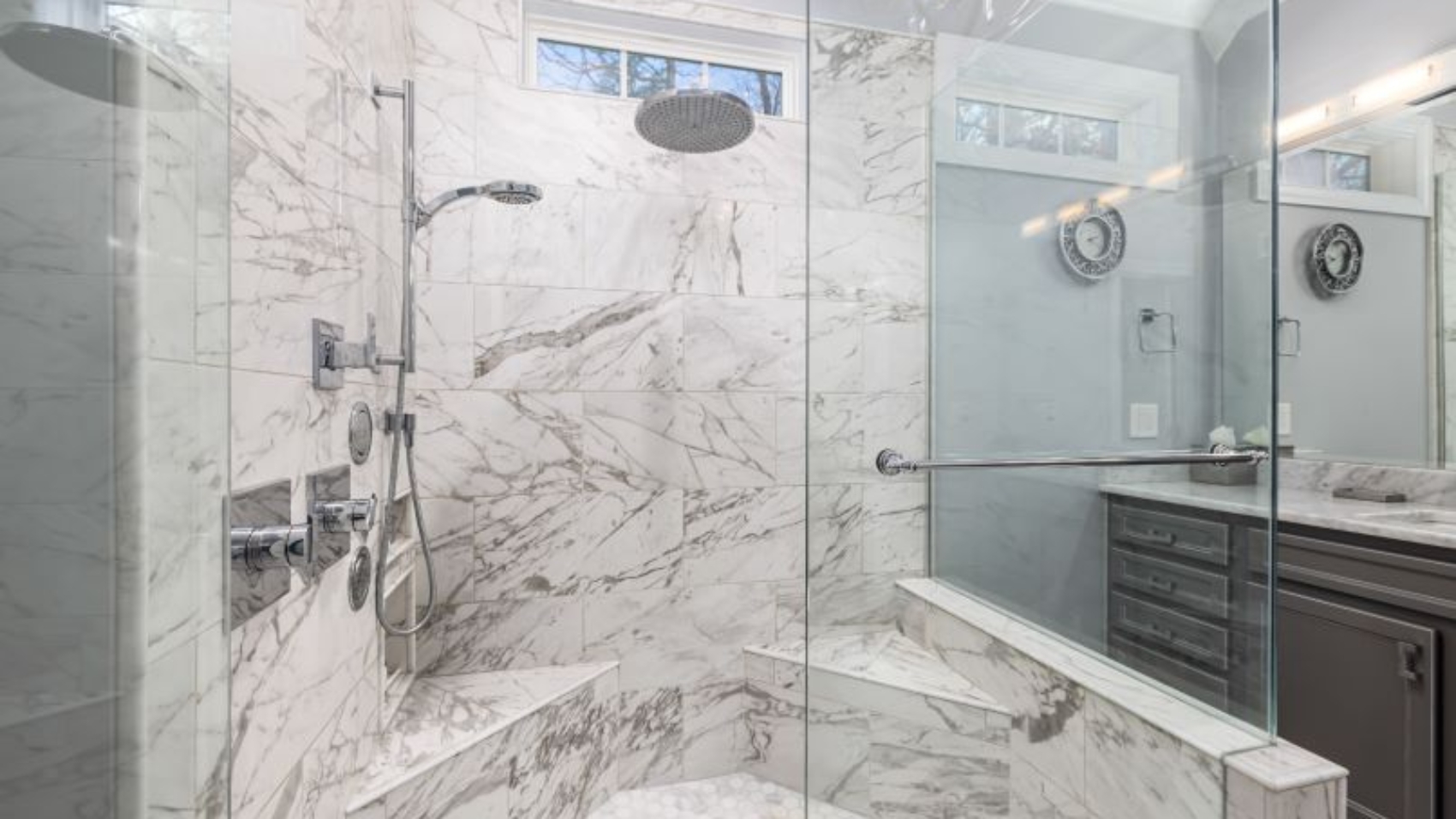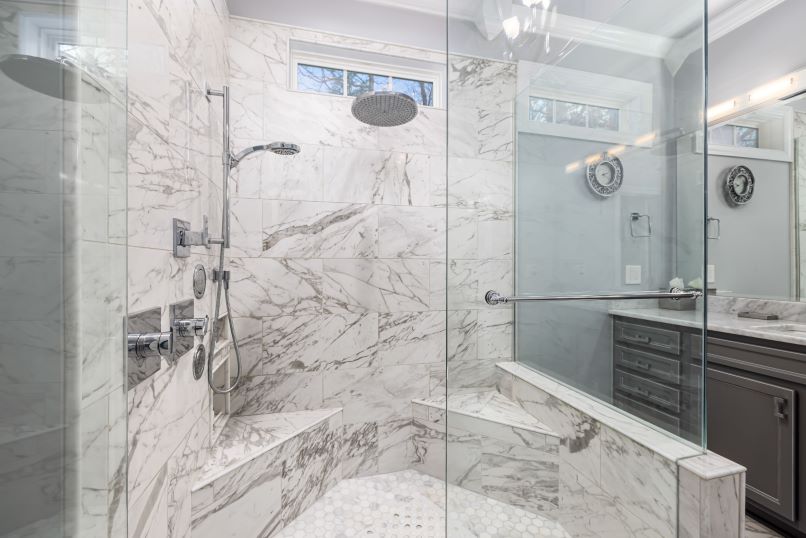
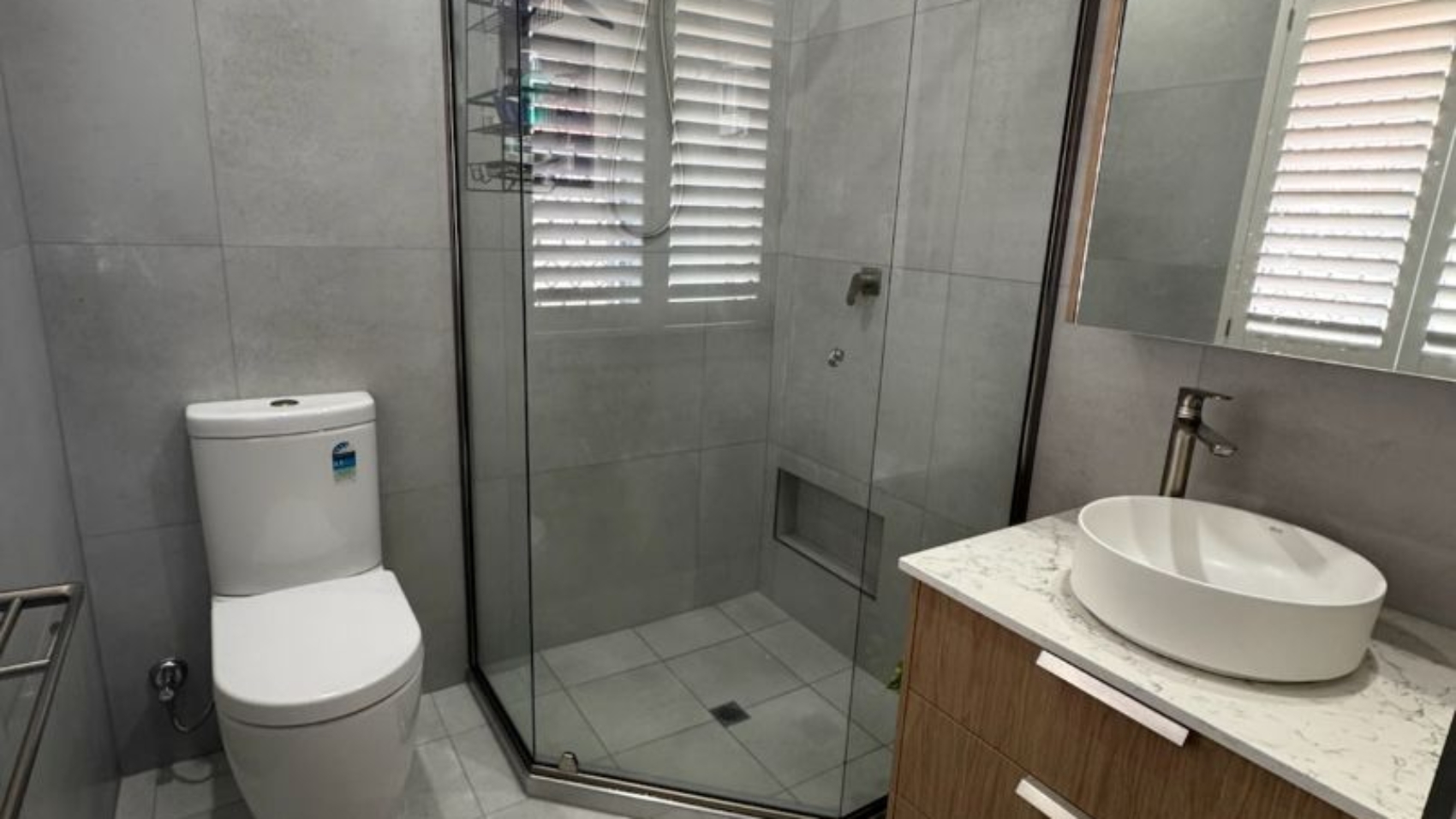
Tiled ensuite showing the shower enclosure, vanity and toilet.

Ensuite Shower Room with a Custom Vanity and Window Shutter: Designing Around You

A well-planned custom ensuite makes the most of the room you have and suits the people who use it. A vanity made for your space, a privacy shutter that handles bathroom conditions and a carefully planned shower can make a compact room work much better than a standard layout.

In the Top End, those choices also need to suit the climate. This guide looks at what to consider when planning an ensuite for a home or commercial property in Darwin, Palmerston or Humpty Doo.
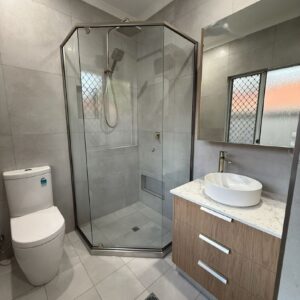
Ensuite renovation with a corner shower, vanity and toilet.

What Does “Ensuite Shower” Mean?

An ensuite is a private bathroom attached directly to a bedroom, most often the main bedroom. It usually contains a shower, vanity and toilet, so the layout needs to make good use of every centimetre.

The word ensuite comes from French. In Australia, it generally means a bathroom accessed from a bedroom rather than from a hallway or shared living area.

Make the vanity fit the room

Standard vanities come in set sizes, but ensuites don’t always have standard dimensions. A unit that’s too wide can crowd the shower screen; one that’s too shallow may leave you short on storage. A custom vanity can be made to suit the wall length, plumbing and clearances in your room.

  • Fit: Cabinetry can be measured to suit pipes, windows and bulkheads, helping doors and drawers open without getting in the way.
  • Storage: Deep drawers, a narrow tall cabinet or a recessed shelf can make a small room easier to keep organised.
  • Style: Choose the door profile, handles, colour and benchtop to work with the rest of the room.

Darwin’s humidity is another factor. Poorly sealed cabinetry can swell or peel when exposed to moisture. Ask about the materials, edges and finishes, and consider a wall-hung vanity or one raised slightly from the floor to make cleaning easier.

Choose a bathroom window shutter with care

A bathroom window needs to balance privacy, daylight and airflow. A window shutter with adjustable louvres can help: angle the blades to admit light and a breeze while limiting the view from outside.

  • Privacy: Adjust the louvres to suit the window’s position and the level of privacy you need.
  • Light control: Tilt the blades to soften strong sunlight while keeping the room bright.
  • Material choice: Look for materials and finishes suited to bathroom moisture, such as water-resistant composite or properly sealed bathroom-grade products. Check the manufacturer’s guidance before choosing.

A shutter can help manage light and airflow, but it doesn’t take the place of an exhaust fan. Good mechanical ventilation remains important for clearing moisture and reducing the chance of mould.
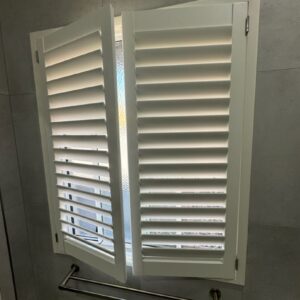
White louvred window shutter fitted in a tiled ensuite bathroom.

Plan the shower before the rest of the layout

In a small ensuite, the shower often sets the limits for everything around it. Start with the wet area, then plan the vanity, toilet and door clearances around it.

A standard enclosure of around 900 x 900 mm is one possible starting point, but the right ensuite shower dimensions depend on the room, screen type and how much movement you want. Measure the available space and check the door swing before settling on a size. A screen that hits the vanity can quickly become a daily frustration.

A double shower may suit couples or anyone who wants a more spacious enclosure, provided the room can accommodate it. A double shower size often starts around 1,200 mm wide and may extend to 1,800 mm or more. The available space, however, has to be balanced against the room needed for the vanity and toilet. A site measure can help determine whether the layout is practical. If you’re considering a double shower head, raise it early so the plumbing and water supply can be planned accordingly.

A few other layout details are worth checking:

  • Keep the toilet out of direct view from the bedroom door where the layout allows.
  • Make sure vanity doors and drawers can open without hitting the shower screen.
  • Consider a frameless or minimal-frame screen to keep the room feeling open.
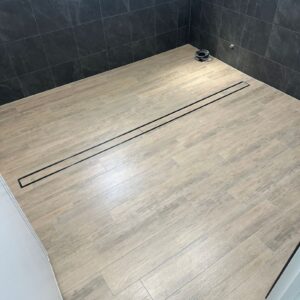
  • Plan the floor waste, floor fall and waterproofing carefully so water drains as it should.
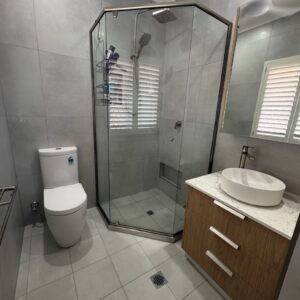
Tiled ensuite showing the shower enclosure, vanity and toilet.

What Is a Peekaboo Shower?

A peekaboo shower is partly visible from the bedroom or vanity area, often through clear glass or an opening in the layout. It can help light travel through a compact room and make it feel more open.

That style won’t suit every household. Think about privacy and how the bedroom connects to the ensuite before deciding. A renovator can help you weigh up where an open view works and where a wall or more enclosed layout makes better sense.

Bring the finishes together

Once the layout is settled, choose a few finishes that work well together. Repeating a small palette often gives the room a calmer feel than mixing too many colours and materials.

  • Tiles: Large-format wall tiles mean fewer grout lines to clean. Choose floor tiles that complement the walls.
  • Vanity and benchtop: Pick colours and textures that sit comfortably alongside the tiles and fittings. A timber-look vanity, for example, can bring warmth to a neutral palette.
  • Fixtures: Using the same finish for tapware, shower fittings and accessories gives the room a consistent look.
  • Shutter and lighting: Match the shutter with the vanity or trim, and use bright lighting around the mirror with softer light elsewhere. 

If you’re gathering ensuite shower ideas, bring a few reference photos to your consultation. They can help your designer understand the look you have in mind.
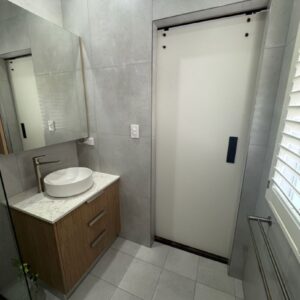
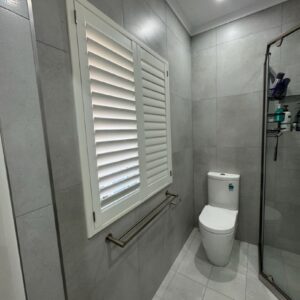
Ensuite vanity and tiled finishes beside a sliding door and window shutter. Bathroom window shutters beside the shower and toilet.

Three-piece or four-piece ensuite?

A four-piece ensuite commonly includes a toilet, basin, shower and bath. Some people use the term differently, so it’s helpful to confirm what’s included when discussing a plan. A four-piece layout needs more room and is usually better suited to a larger main bedroom or commercial suite.

For a compact ensuite, a three-piece layout with a well-planned shower may be the more comfortable fit.

What affects the cost of an ensuite renovation?

Costs depend on the size of the room, whether the layout changes, and the choices you make for plumbing, tiling, joinery and fittings. A simple refresh is different from a full rebuild that includes new waterproofing, a custom vanity and a shutter.

The best way to get a realistic estimate is to have the room measured and talk through your priorities. If you’re considering a wider shower or a second shower head, mention it early so the layout and plumbing can be discussed together.

Why Trust Itile Bathrooms NT for Bathroom Renovations in Darwin, NT?

Itile Bathrooms NT is a Darwin-based business focused on bathroom renovations in the Top End. Local experience matters here, because humidity, the wet season and tropical conditions put extra demands on waterproofing, ventilation and materials. Working in the area means understanding what suits homes in Darwin, Palmerston and Humpty Doo, from compact ensuites to commercial wet areas.

You can speak to the team directly about your plans and ask how they’d approach waterproofing, layout and finishes for your space. A clear conversation before work starts is the best way to confirm the details suit your property and budget.

Request Your Custom Ensuite Quote

If you’re ready to turn an ordinary ensuite into one designed around you, get in touch with a few measurements or photos and tell us what you want from the space. We’ll talk through your options, including a custom vanity, window shutter and shower layout.
Call +61 400 729 303 | Contact Itile Bathrooms NT

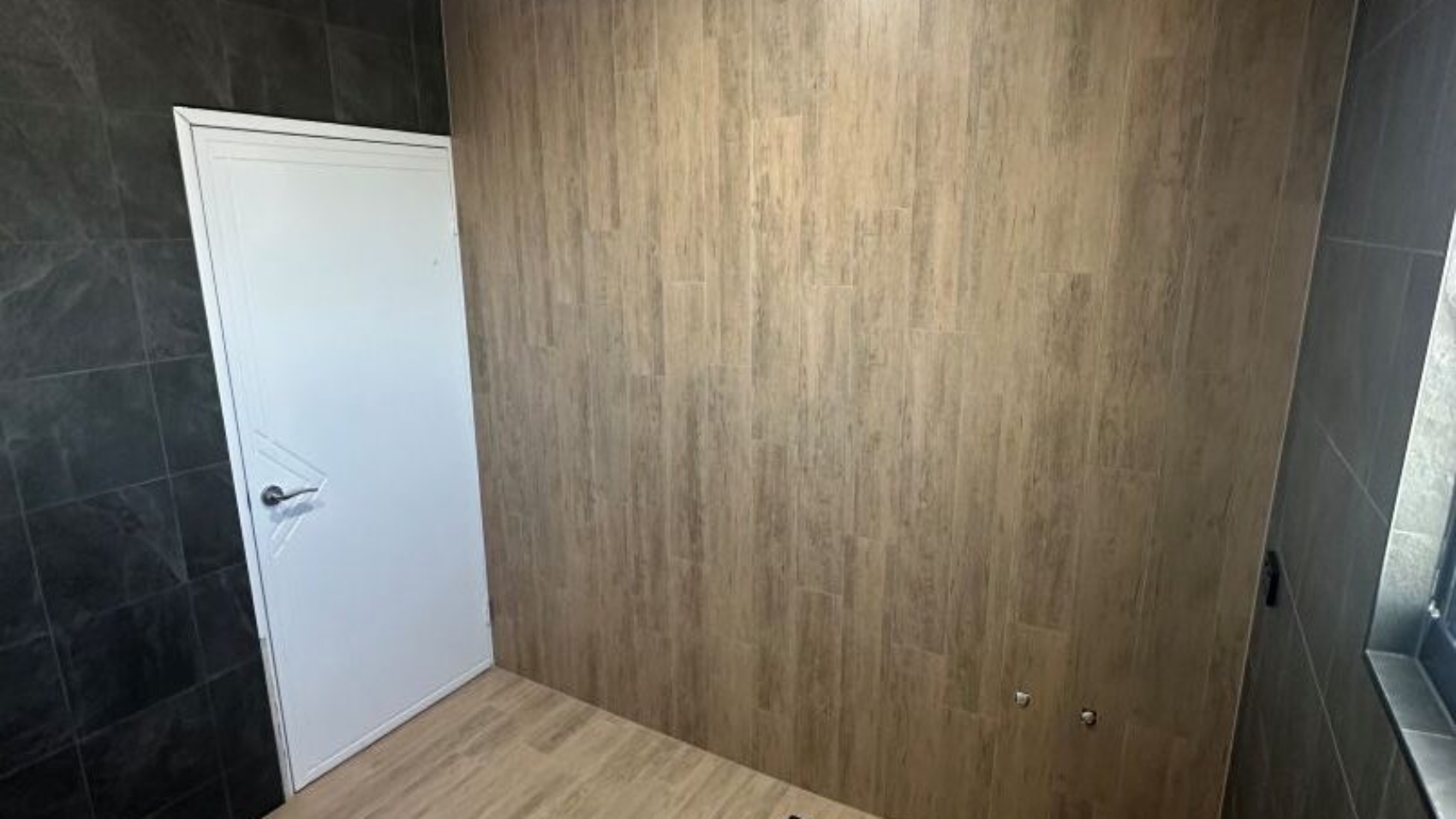
Bathroom with a timber-look tiled wall and floor alongside dark slate tiles

Wood Grain Plank Tiles with Slate: A Natural Look That Lasts

Wood grain plank tiles and slate bring two natural textures together: the warmth of timber and the depth of stone. You get that relaxed, earthy look without putting real wood in a room that’s regularly wet.

That can be a practical choice in Darwin, Palmerston and Humpty Doo, where heat and humidity can make it harder for bathrooms to dry out. It also works in family homes, rental properties and commercial spaces.

Alt text: Wood grain plank tiles paired with dark slate wall tiles in a bathroom.

Why do wood grain plank tiles work in wet areas and humid climates?

Real timber and moisture don’t get along. Wood swells, cups, stains and can grow mould when it’s exposed to steam and splashes day after day. Bathrooms in the Top End rarely get a proper chance to dry out during the wet season, so timber floors often struggle.

Porcelain and ceramic planks are fired and printed to copy the look of oak, spotted gum or weathered driftwood. The material underneath doesn’t soak up water the way timber does, so the planks keep their shape and colour. That’s the main reason timber look tiles have become so popular for bathrooms, laundries and commercial amenities across the Northern Territory.

Modern printing has also come a long way. Good planks have varied grain patterns, knots and subtle colour shifts, so a floor doesn’t look like one pattern copied over and over.

How does slate add depth to a timber-look space?

Plank tiles are warm, linear and smooth. Slate tiles are cooler, darker and heavily textured. Put them together and each material makes the other look better.

A feature wall is the easiest place to try it. Think of the wall behind a freestanding bath or vanity, or the inside of a shower recess lined in charcoal slate, with timber-look planks running across the floor. The stone texture catches light and draws the eye, while the planks keep the room from feeling heavy or cold.

A few things help the mix work:

  • Choose one main surface. Planks on the floor and slate on one wall can create a clearer focal point than dividing the room evenly between both materials.
  • Check the undertones. Honey-coloured planks often sit well with brown-grey slate; pale ash tones tend to suit cooler charcoal shades.
  • Consider slate-look porcelain. Natural slate is porous and generally needs sealing. Porcelain alternatives can give you a similar look with less ongoing care.

Bathroom with a timber-look tiled wall and floor alongside dark slate tiles

What are the practical benefits?

The biggest advantage is that you get the appearance of natural materials with far less maintenance. Porcelain planks resist water and don’t need oiling, sanding or re-coating. Day-to-day cleaning is usually a mop and a mild cleaner, which is a real plus in a low maintenance bathroom that gets used by a busy household or hundreds of visitors a week.

Durability matters as well. Quality tiles are made to handle regular foot traffic and everyday knocks. For businesses, fewer repairs can mean less disruption. At home, it means a floor that can keep looking good with routine care.

Slip resistance matters too, particularly for bare feet in a wet room. Look for non-slip tiles with a finish suited to the area, and ask for the slip rating of any tile you’re considering. Ask about the tile’s slip rating and whether its finish is suitable for the area where you plan to use it.

What layout and installation tips matter most?

The tile itself is only half the story. How it’s laid and what sits underneath it make a big difference to how it performs.

Direction. Running planks along the length of a narrow ensuite makes it feel longer. In a wider room, many people lay them toward the main light source or the door so the grain lines lead the eye in.

Joint offset. Long planks can bow slightly. Many tilers offset the joints by around one-third rather than half to reduce uneven edges, but always check the manufacturer’s guidance for the tile you’ve chosen.

Grout colour. Matching the grout colour to the plank gives a seamless, timber-like finish. A deeper grout beside slate emphasises its texture. Keep the grout lines narrow on planks so the floor reads as one surface, and think about how easily lighter grout shows dirt in a high-traffic space.

Waterproofing. This is the step you can’t see and shouldn’t skip. Wet areas in Australian homes need a proper membrane applied before tiling, and AS 3740 covers waterproofing of domestic wet areas. Good waterproofing and solid surface preparation protect the structure behind your tiles, which matters even more in Darwin’s wet season. Your tiler should also match the adhesive to the tile and conditions. Your tiler should also choose an adhesive suited to the tile and site conditions.

Bathroom renovation featuring wood grain tiles across the shower wall and floor, with slate tile accents.

What does the finished look like?

Photos can help you picture the overall effect, but the colour and texture can change with the light in your own bathroom. If you’re choosing between finishes, compare samples in the space where they’ll be installed.

These Itile Bathrooms NT project photos show a few ways to bring wood grain tiles and slate together:

Walk-in shower with pale wood-look floor tiles and charcoal slate wallsWood grain plank flooring with dark slate-look tiles on the shower walls Close view of wood-look plank tiles beside dark slate tiles in a walk-in shower.

Thinking about a similar look for your bathroom? Book a tile consultation and we can talk through samples, layouts and what may suit your space.

Why trust Itile Bathrooms NT for bathroom renovations in Darwin?

Itile Bathrooms NT is a Darwin-based business focused on bathroom renovations, so the advice reflects Top End conditions: heat, humidity and the wet season. Tile choice, layout, waterproofing and finishing are planned together rather than treated as separate jobs, which is how a bathroom renovation Darwin property owners can rely on tends to come together. We work with residential and commercial clients, and you can see more of our advice on the Itile Bathrooms NT blog.

FAQs

Are wood grain plank tiles good for Darwin bathrooms?

Yes. They resist moisture far better than real timber and handle humidity well when installed over a properly waterproofed substrate.

Can you mix wood-look planks with slate?

Yes. Use planks for the floor and slate on a feature wall or shower area, and keep undertones consistent.

Do wood-look tiles need sealing?

Most porcelain planks don’t. Natural slate usually does, so check the product before you buy.

Ready to plan your tile look?

Whether you’re updating a family bathroom in Palmerston, a rural home in Humpty Doo or a commercial space in Darwin, we’re happy to talk through your options.

Call +61 400 729 303 | Contact Itile Bathrooms NT

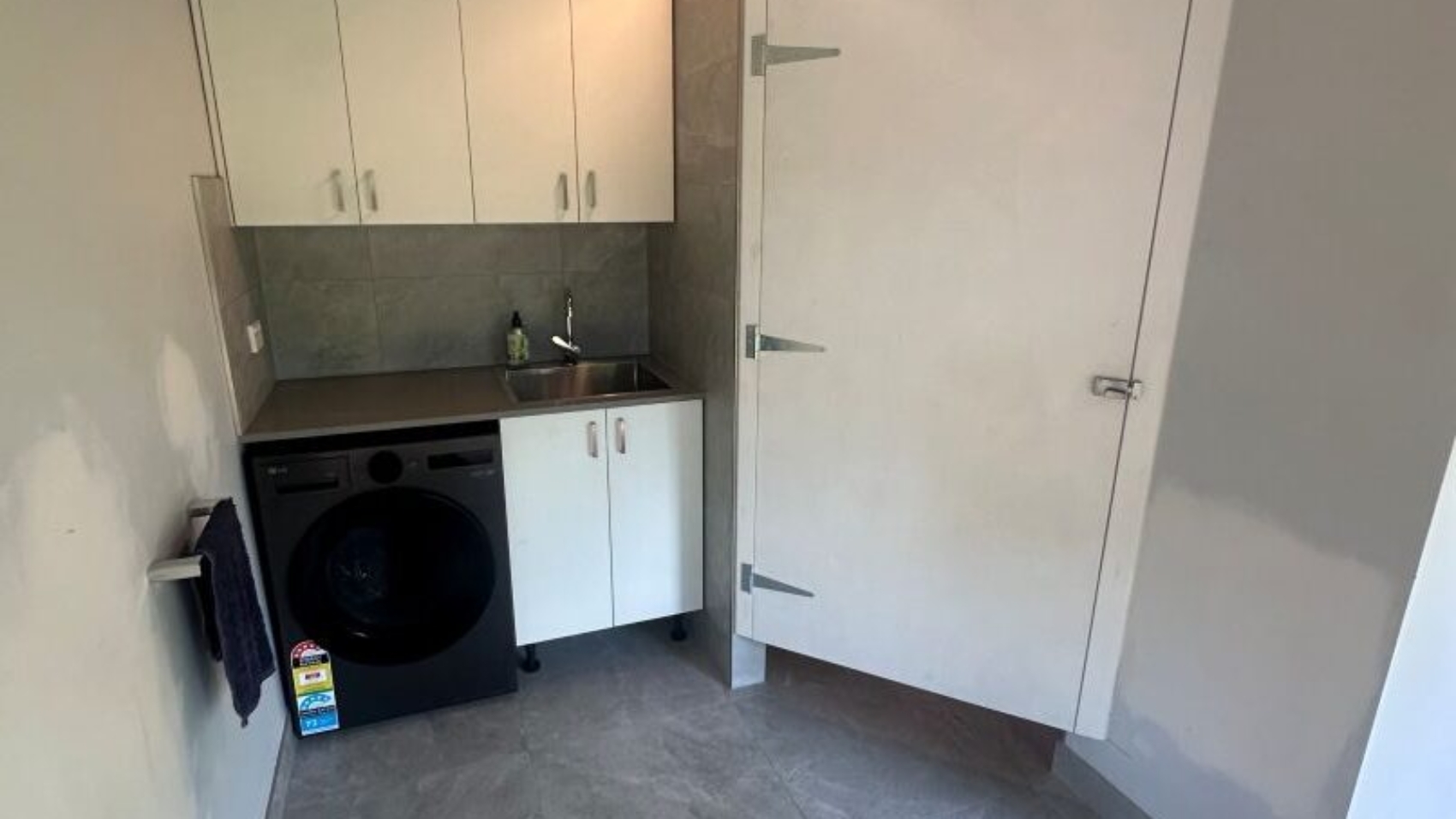
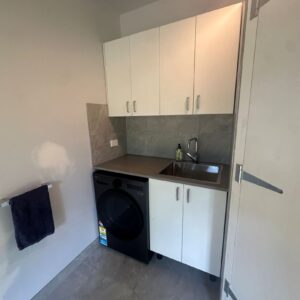
Renovated laundry with washing machine, sink and overhead cupboards.

Laundry Renovation: Adding a Toilet Where You Never Had One

Can you add a toilet to a laundry? Yes, in most cases you can. Laundries already have water and drainage, and their floors are built to handle everyday wear. That can make them a practical place for a second toilet, though the layout and plumbing still need to work.

The job usually involves a licensed plumber, a new framed and lined wall, and waterproofing around the wet area. Get those details right and you can make better use of the space, save a few steps during busy mornings and add a useful feature to your home.

Why add a toilet to a laundry?

For many families, it comes down to queues. When the household is busy with kids, shift workers or visitors, one toilet can feel like one too few. A second toilet near the back door is also handy after a swim, a day in the garden or a muddy walk. No one has to traipse through the house first.

The same idea can work for small offices, workshops, cafés and rental properties. If there’s already a laundry or utility room near the back of the building, part of it may be suitable for a toilet. That can give staff or tenants another facility without building an extension.

A second toilet can also appeal to future buyers in Darwin, Palmerston and Humpty Doo. Many laundries in the Top End are already close to plumbing, which may make the work simpler than creating a new bathroom elsewhere. The actual cost depends on the room and how much needs to change.

If you’re considering laundry renovation ideas, a compact toilet nook may be worth exploring—even when space is limited.

How the new toilet area is built

It starts with the layout. The toilet needs enough room to use comfortably, while the washer, dryer and a place to fold clothes still need to fit. Sorting that out before demolition can help avoid changes once the work is underway.

The new wall is often built with a steel stud frame. Steel won’t swell or warp like timber, and it isn’t susceptible to termites. Those qualities can be useful in Darwin’s humid, wet-season climate. Once the frame is in place, moisture-resistant sheets are fitted and the plumbing is roughed in before the wall is closed.

Waterproofing is another part of the job to get right. A toilet area isn’t a shower, but floors can still get wet from leaks, spills and mopping. A properly waterproofed floor helps protect the slab and nearby rooms. Our blog on waterproofing and wet season protection explains more about looking after wet areas in the Top End.

Adding a toilet involves plumbing and drainage, so a licensed plumber needs to do that work. Approval may also be required before you start. Check with the NT Government or your local council, or ask your renovator to confirm the requirements for your property.

Why a custom plywood door suits the space

In a compact laundry, a standard hinged door can get in the way. It might hit the washing machine or leave little room to walk past. A custom plywood door can be made to suit an awkward opening and the size of the toilet nook. It can also be hung to open in a direction that works better for the room.

Plywood is strong and relatively light, which helps keep the door manageable. It can be painted or given a clear finish to suit the rest of the laundry. In humid conditions, seal all faces and edges to help protect it from moisture and keep it in shape.

New cupboards and a stone benchtop

Once the toilet area is planned, it’s a good time to look at the rest of the laundry. Cupboards can keep detergent, cleaning products, towels and spare toilet rolls out of sight, leaving more room on the bench. Full-height cabinets, overhead cupboards and slim pull-outs can all make use of otherwise overlooked space.

A stone benchtop gives you a durable surface for folding clothes and sorting washing. When properly sealed and installed, it can stand up to everyday knocks and damp conditions. It’s also easy to wipe clean after detergent spills or a wet basket has been on the bench.

If space is tight, small laundry renovation ideas include stacking the washer and dryer, adding a narrow bench and using the wall for storage. Modern laundry renovation ideas might include flat-panel cabinets, a simple colour scheme, concealed storage and larger tiles with fewer grout lines.

What does a laundry renovation cost?

There’s no standard price. The cost depends on what needs to be done, including plumbing, new walls, waterproofing, tiling, cabinetry and the benchtop. A straightforward refresh will usually involve less work than changing the layout and adding a toilet.

For laundry renovation cost questions, the most reliable approach is to get a written quote based on your actual room and plans. If you’re working to a tight budget, laundry renovation ideas on a budget might include keeping the existing washing machine position, choosing durable but affordable surfaces and spending more on the parts that are hard to change later, such as waterproofing and plumbing.

Before and after

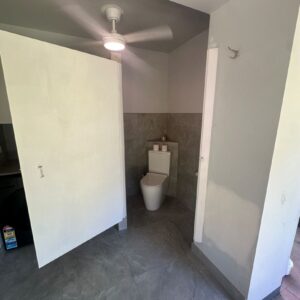
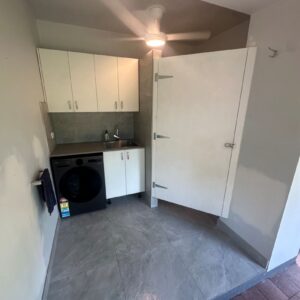
The finished space shows how a laundry can make room for a separate toilet while keeping the washing area practical. The toilet nook is screened behind its own door, and the laundry has cupboards and a clear work surface for everyday use.

Toilet tucked behind a door in a renovated laundry

The new toilet nook, set beside the laundry

Renovated laundry with washing machine, sink and overhead cupboards.

The renovated laundry with overhead cupboards and room for the washing machine.

Laundry cabinetry, sink and washing machine in a compact space.

Laundry storage and cabinetry arranged around the washing machine.

Why trust Itile Bathrooms NT?

Itile Bathrooms NT is based in Darwin and focuses on bathroom renovations. That wet-area experience is relevant when converting a laundry, where careful planning, waterproofing, tiling and a tidy finish all matter. We work with homeowners and commercial clients across Darwin and the surrounding region, and we’re familiar with the way local conditions can affect materials and construction.

Before work begins, ask any contractor to confirm their licensing, insurance, scope and timeframes in writing. We’re happy to talk through those details too, so you can understand what the job involves.

Planning a laundry makeover in Darwin, Palmerston or Humpty Doo?

Searching for laundry renovations near me? Get in touch and we can talk through your space, the options and what may be possible. Whether it’s a family home, rental or commercial property, a conversation is a good place to start.

Call Itile Bathrooms NT | Contact Itile Bathrooms NT

FAQs

Can any laundry fit a toilet?

Not always. It depends on the available space, access to drainage and the location of existing plumbing. A site inspection can help confirm what’s possible.

Do I need approval to add a toilet?

You may. Plumbing and drainage work can require approval, so check with the NT Government or your local council before starting.

How long does a laundry renovation take?

It depends on the work involved. A simple update may take less time than a full conversion with a new wall, plumbing, waterproofing and cabinetry.

Is a stone benchtop a good choice in the Top End?

It can be, when sealed and installed correctly. Stone is suited to everyday wear, humidity and spills.

failed bathroom waterproofing

Only One Bathroom and the Waterproofing Has Failed? How to Get Through the Renovation in Darwin

You’ve found out the waterproofing has gone, and the first thing you think about is where everyone is going to shower. It’s a fair worry. When it’s your only bathroom, the renovation affects how the whole house runs, not just one room.

The Short Answer

Most households manage by setting up temporary arrangements for the weeks the bathroom is out of action: showering at a gym, pool or a friend’s or relative’s place, using a portable toilet or a neighbour’s, or staying elsewhere for the worst of it. Exactly how long you’re without a bathroom depends on the condition of the room, the materials, any approvals and how the trades line up. Your renovator should give you a realistic schedule after seeing the job.

What Happens When The Only Bathroom Has To Be Stripped Out?

If failed bathroom waterproofing is the problem, new tiles over the top won’t fix it. The tiles are only the surface. The waterproof membrane underneath is what keeps water out of the floor and walls, and once it’s failed, the old tiles, bed and often the membrane have to come out so the area can be rebuilt properly.

Once the room is opened up, you may find the damage goes further than the surface suggested: soft or swollen sheeting, marked framing, or a floor that’s been taking on moisture for a while. That’s why a good renovator will say upfront that some things can’t be confirmed until the walls and floor are exposed. It isn’t a way of padding the job. It’s how these jobs go.

How Long Will We Be Without A Normal Bathroom?

It varies, and anyone who gives you a fixed number before seeing the room is guessing. The main things that affect it:

  • how much damage is found once the old lining is removed
  • whether framing or flooring needs repairs
  • membrane curing times before tiling can start
  • tile and fixture availability
  • any approvals or other trades involved, such as plumbing and electrical

Plan for the bathroom being unusable for a good stretch rather than a few days, and ask your renovator to break the job into stages. Some stages will be messy and some will be quiet, and you can plan around that.

Where Can We Shower If We’ve Got Nowhere Else?

People get creative here. Common options in Darwin:

  • Gym or pool showers. A membership or casual entry often covers it, and it fits well with work or school routines.
  • Friends or family. Many people do a roster, with each person showering at a different place.
  • Caravan park or holiday accommodation. Worth considering for a week or two, especially for families.
  • Workplace facilities. Some workplaces have showers, particularly for people who ride or run in.
  • Outdoor shower. If you already have one, great, but don’t install anything that needs plumbing without checking with your plumber first.

For a quick wash, a basin of warm water in the laundry or kitchen does the job. In Darwin’s heat, you’ll probably want to shower more than once a day, so ask yourself honestly how often you’ll need somewhere to go.

Can The Toilet Stay Usable During The Renovation?

Sometimes, but not always. If the toilet is in the same room as the shower, it usually has to be disconnected when the floor and walls are being worked on, and again when the waterproofing and tiling are done. If the toilet is in a separate room, it may stay available for most of the job.

Ask your renovator exactly when the toilet will be out. Often it’s only a few days at a time, and you can plan for those days by using a neighbour’s, a public toilet near work or a hire portable toilet. If you’re a landlord or property manager, check what your tenants can reasonably be expected to put up with and whether alternative arrangements need to be offered.

Planning Around Work, School, Kids, Elderly Family Members And Tenants

A few things make a real difference:

  • Work and school. Shower the night before or at work or the gym. Keep uniforms and bags somewhere clean, away from the dust.
  • Young children. Think about bath time and toileting accidents. A potty or a kids’ toilet seat in a clean part of the house can help.
  • Elderly or less mobile household members. Stairs, distance to the toilet and slippery temporary setups matter. It may be easier for them to stay with family for the stretch.
  • Tenants. Talk early, in writing, and agree on what’s reasonable. Check your lease and your obligations.

What To Ask Your Bathroom Renovator Before Work Starts

Before you agree to anything, ask:

  1. How long will each stage take, and when will the toilet and shower be out of use?
  2. What happens if the strip-out reveals more water damage?
  3. How will dust and noise be managed?
  4. When does the waterproofing go in, and how long before tiling can start?
  5. What will you do if materials are delayed?
  6. How will we be told if the schedule changes?

Clear answers to these questions are a good sign. Vague answers are worth noticing.

What Happens If Waterproofing Problems Are Ignored?

It depends on the bathroom, but moisture that keeps getting past the membrane can damage the floor and wall linings and the framing, and can lead to mould, drummy tiles and ongoing leaks. In some cases the problem shows up in the room next door before you see anything in the bathroom itself. The longer it goes on, the more there is to fix, and a bathroom renovation due to water damage can end up bigger than it needed to be.

Things To Think About In Darwin’s Climate

Darwin’s heat and humidity are hard on bathrooms. Rooms stay damp for long periods, ventilation matters, and the wet season can slow down deliveries and some of the work, particularly when materials need to dry or cure. If you can, it’s worth planning a complete bathroom renovation Darwin homeowners can live with around the Wet and the Dry rather than starting in the middle of a big storm. Good bathroom waterproofing Darwin properties rely on is done properly the first time, because the climate doesn’t give a poor job much of a chance to hide.

Why Choose Itile Bathrooms NT?

If you’re searching for bathroom renovation Darwin NT options, you want someone who’ll deal with the waterproofing properly and talk to you about how you’ll live during the job. Itile Bathrooms NT is a Darwin business that does bathroom renovations, and when the problem is failed waterproofing, the conversation can start with your actual situation: one bathroom, a household that still needs to function, and a realistic plan for the work. That’s the part many people want help with.

FAQ

Can I live in my house during a bathroom renovation if it’s my only bathroom?

Usually, yes, but you’ll need temporary arrangements for showering and, at times, the toilet. Many households stay home and shower at a gym, pool or a friend’s place. Others move out for the messiest stages. It depends on your household, how long the bathroom is out of action, and how much disruption you’re comfortable with.

Can I just re-tile over failed waterproofing?

No. Tiles are the surface layer, and the waterproof membrane underneath is what protects the floor and walls. If the membrane has failed, the old tiles and bed generally have to be removed so the area can be rebuilt properly. Tiling over it only hides the problem.

How do I know if my bathroom waterproofing has failed?

Common signs include water stains or swelling on walls next to the bathroom, drummy or loose tiles, grout that keeps cracking or going mouldy, a musty smell, damp carpet or flooring outside the bathroom door, and paint that bubbles or peels. None of these proves failure on its own, so get the room properly assessed rather than guessing.

Is it better to renovate during the Wet or the Dry?

The Dry tends to be easier for deliveries, access and drying, but the best time depends on your situation, the urgency of the problem, and trade availability. If waterproofing has already failed, waiting for a better season can let water damage get worse, so it’s worth talking to your renovator about what’s realistic.

What should landlords and property managers do if a tenant’s only bathroom needs a full renovation?

Speak to the tenant early and put the plan in writing, including what work is happening, the likely timeframe, and when the shower and toilet will be unavailable. Check your lease and your obligations, and consider what alternative arrangements may be needed. The right approach varies by property and tenancy, so get advice if you’re unsure.

Talk It Through Before You Decide

If your waterproofing has failed and you’re not sure how you’d cope without your only bathroom, it’s worth talking it through before you commit to anything. A conversation about the room and your household can help you work out the order of the job, and what sort of bathroom renovation Darwin residents with one bathroom can actually live with.

Call Itile Bathrooms NT on +61 400 729 303, or get in touch through the website: https://itilebathroomsnt.com/contact/

am I being ripped off for a bathroom reno

Am I Being Ripped Off for a Bathroom Reno?

You’ve got a quote in your hand, or you’ve already paid a deposit, and something feels off. Maybe the number is higher than you expected. Maybe it’s a single line that says “bathroom renovation” with a price next to it. Either way, it’s reasonable to stop and ask whether you’re being ripped off.

So, Am I Being Ripped Off For A Bathroom Reno?

Not necessarily. A high quote isn’t automatically a rip-off, and a low one isn’t automatically a bargain. The real test is whether you can see what you’re paying for.

A fair quote lets you trace the major costs to a specific job, material or trade. A poor one hides behind vague wording and round numbers. If you can’t tell what’s included, that’s the problem to fix first, before you argue about the total.

Why Do Bathroom Reno Quotes Vary So Much?

Two quotes for the “same” bathroom are often for different jobs. One might include replacing the floor waste, new waterproofing and a full tile allowance. Another might assume the existing waste is fine and leave the tiles as a “to be selected” item. The totals look far apart, but you’re comparing different scopes.

Quotes also differ because of the assumptions behind them. A builder who allows for problems behind the walls will price differently from one who hopes there won’t be any. Neither is necessarily dishonest, but you need to know which approach you’re looking at.

What Can Legitimately Make A Bathroom Renovation More Expensive?

Actual costs depend on the size and condition of the room, your choice of materials and fixtures, and how much work is involved. The main factors are:

  • Bathroom size and layout, especially if the shower, toilet or vanity is moving
  • Plumbing changes, such as relocating pipes or replacing old ones
  • Electrical work, like new lighting, exhaust fans or power points
  • Waterproofing, which is a skilled job and should never be treated as optional
  • Demolition and rubbish removal, which is harder in some homes than others
  • Tile choice and layout, since large-format tiles, patterns and lots of cuts take more time
  • Fixtures and fittings, where the range from basic to premium is enormous
  • Access, such as upstairs bathrooms or units with limited parking
  • Hidden damage found once the old walls and floor come out

What Should A Bathroom Renovation Quote Clearly Explain?

You shouldn’t need to decode it. A transparent quote normally covers:

  • A description of the work, room by room, step by step
  • What’s being removed, and who disposes of it
  • Plumbing, electrical and waterproofing work
  • Tiling, including the area covered and any allowances
  • Fixtures: who supplies them, and which brands or models
  • The payment schedule
  • An estimated timeframe
  • How variations (changes or extra work) will be priced and approved

Pay particular attention to allowances. A “tile allowance” or “fixtures allowance” is a set amount for items you haven’t chosen yet. If your selections cost more, so does the job. That’s fine, as long as the amount is realistic and written down.

Warning Signs A Quote Isn’t Transparent

Be cautious if you see:

  • One lump sum with no breakdown
  • Allowances with no amounts attached
  • Pressure to sign today to “lock in” the price
  • A large upfront deposit with nothing tied to work completed
  • No mention of waterproofing
  • No licence details for plumbing or electrical work
  • Reluctance to put things in writing
  • Answers to your questions that stay vague

Any one of these doesn’t prove anything, but several together are worth taking seriously.

Is The Cheapest Quote The Cheapest Reno?

Often it isn’t. A low price can mean something has been left out, and you find out later through variations. It can also mean corners are being cut where you can’t see them, like waterproofing or surface preparation. Fixing a leaking shower means tearing out tiles you’ve already paid for, so the “saving” disappears fast.

Questions To Ask Before You Say Yes

  • What exactly is included, and what isn’t?
  • Which items are allowances, and how much is each?
  • Who does the plumbing, electrical and waterproofing, and are they licensed?
  • What happens if you find damage when the walls come off?
  • How are variations quoted and approved?
  • What’s the payment schedule?
  • How long will it take, and how long are the bathroom and toilet out of action?

Darwin and NT Considerations

Darwin’s climate matters for bathrooms. High humidity and a long wet season put constant pressure on ventilation and moisture control, so ask how the quote deals with exhaust fans and mould-prone areas.

Waterproofing is the other big one. Wet areas in Australian buildings are expected to meet relevant standards, and the work should be done properly and documented. Ask what the process is and how it will be checked. For the specific rules that apply to your property, check with the relevant NT authorities.

Other local points can affect cost:

  • Older homes may hide moisture damage, termite damage or materials that need testing, such as asbestos in some pre-1990 buildings
  • Units and apartments may need body corporate approval before work starts
  • Some products may need to be freighted to Darwin, which can affect lead times and sometimes price

Landlords and commercial property owners should also ask about working hours, tenant access and how disruption will be managed.

A Quick Checklist For Comparing Bathroom Renovation Quotes

  1. Is the scope identical across all quotes?
  2. Are the allowances listed with amounts?
  3. Are waterproofing, plumbing and electrical work clearly included?
  4. Is the demolition and rubbish removal covered?
  5. Are the fixtures and tiles specified, or just described loosely?
  6. Is the payment schedule tied to progress?
  7. Is there a clear process for variations?
  8. Can the business show licence details?

If two quotes differ by a lot, line them up against this list. The gap usually comes down to one or two items.

Why Some Darwin Customers Choose Itile Bathrooms NT

Itile Bathrooms NT focuses on bathroom renovations in Darwin, NT, so the local conditions above are part of the day-to-day work rather than something to look up. If you want a professional to talk through your bathroom, explain what’s involved and put the scope in writing, it’s a sensible place to start. Ask them the questions in this article. A good business should be comfortable answering them.

Not Sure About Your Quote?

If you’re planning a bathroom renovation, or you’ve got a quote you’d like a second opinion on, get in touch with Itile Bathrooms NT. Call 0400 729 303 or visit https://itilebathroomsnt.com/contact/ to talk through what you need.

FAQ

What should a bathroom renovation quote include?

A clear description of the work, demolition and rubbish removal, plumbing, electrical and waterproofing, tiling details, who supplies the fixtures, the payment schedule, a timeframe and how variations are handled. If any of these are missing, ask for them in writing.

Is a bathroom renovation quote with one lump sum a red flag?

It’s a reason to ask questions. A single figure makes it impossible to compare quotes or see what you’re paying for. Ask for a breakdown by stage or trade, and for any allowances to be listed with amounts.

What is a provisional sum or allowance?

It’s a set amount in the quote for something not yet chosen or fully known, such as tiles, fixtures or hidden repairs. If the final cost is higher than the allowance, you pay the difference, so check the amount is realistic.

What are variations, and can they blow out the cost?

A variation is any change to the agreed scope, such as extra work, upgraded fixtures or repairs found once the walls come off. They’re normal, but each one should be priced and approved by you in writing before the work goes ahead.

Why do bathroom renovation costs differ between quotes?

Usually because the scope, materials or assumptions differ. One quote might include waterproofing, new plumbing and a realistic tile allowance, while another leaves them out or glosses over them. Compare the detail, not just the total.

Are there hidden costs in a bathroom reno?

They usually come from things the quote didn’t mention, like damage behind walls or floors, unclear allowances, rubbish removal or plumbing and electrical changes. Asking what’s included and what isn’t, before you sign, is the best protection.

Should I get more than one bathroom renovation quote in Darwin?

Yes, if you’re unsure. Ask each business to quote on the same scope, then use the checklist above to compare them line by line.

things to know before renovating a bathroom

Things You Wish You Knew Before You Renovated Your Bathroom

Most people start a bathroom renovation Darwin project thinking it’s mostly about tiles and a vanity. The regrets usually come from what’s behind the walls, what humidity does over time, and what wasn’t written down at the start. This guide covers the things to know before renovating a bathroom in the Top End, whether it’s a home or a commercial property.

What Do People Underestimate Before Renovating A Bathroom?

Three things: how many trades are involved, how much happens before any tile goes down, and how long decisions take. Plumbing, electrical, waterproofing, tiling, glazing and joinery all have to happen in the right order, and a delay in one holds up the rest.

Bathroom renovation planning is where most problems are won or lost. Locking in the layout, fixtures and materials before demolition means fewer “while we’re at it” changes halfway through, and those changes are what push jobs over time and budget.

Why Do Bathroom Renovation Costs Blow Out?

“The quote blew out” is one of the most common complaints. It usually comes from a few predictable places:

  • Hidden damage found after demolition, like rotted framing, old leaks or corroded pipework
  • Moving the toilet, shower or drain, which means moving plumbing
  • Fixtures chosen after the quote, at a very different price to the allowance
  • Vague quotes that say “supply and install tiles” without saying what’s included

Realistic bathroom renovation costs depend on size, layout changes, finishes and what’s found once the old bathroom is stripped out. Ask for an itemised quote, find out what’s an allowance and what’s a fixed price, and keep a contingency aside. If one quote is far cheaper than the others, ask what’s been left out.

How Long Does A Bathroom Renovation Actually Take?

Longer than most people expect. Waterproofing membranes need cure time before tiling, and tiles and grout need to set before the shower is used. Special-order items like frameless glass or custom vanities can take weeks to arrive.

The wet season, roughly November to April, can add complications such as delivery delays and slower drying times. Ask for a sequence of works, not just a finish date, and ask what happens if something is back-ordered. If it’s your only bathroom, plan where you’ll shower.

Why Does Bathroom Waterproofing Matter So Much?

Because the problem stays hidden until it’s expensive. Bathroom waterproofing is the membrane under the tiles that stops water reaching the walls, floor and framing. Tiles and grout aren’t waterproof on their own.

When it’s done badly, you end up with the things people describe as a “leaking shower”, “water coming through the wall”, “tiles popping off” or a “musty smell we can’t find”. By the time you notice, the substrate is often damaged and the tiles have to come out.

Waterproofing of wet areas in Australia is covered by the National Construction Code and Australian Standard AS 3740. Ask who is doing the waterproofing, whether they’re appropriately licensed, and what documentation you’ll receive. Take photos before the tiles go over it.

How Do You Deal With Ventilation And Mould In Darwin’s Humidity?

Darwin is hot and humid for much of the year, so moisture doesn’t dry out the way it does in a drier climate. Without airflow, steam settles on ceilings, grout and corners, and mould follows.

Good bathroom ventilation means an exhaust fan that’s the right size for the room and actually vents outside, not into the roof space. A fan that only pushes air into the ceiling cavity is a common cause of “mould on the ceiling”. Think about where the fan sits relative to the shower, whether there’s a window or louvres, and how long the fan runs after showering.

Bathroom mould prevention is a combination of the right fan, a floor sloped so water drains rather than pools, well-sealed joints, and materials that don’t hold moisture. Cleaning helps, but it can’t fix a room that never dries.

Which Materials Suit Darwin Conditions?

Choose materials for how they handle heat, moisture and daily use, not just how they look.

  • Tiles: Check the slip rating for wet areas, and consider fewer grout lines where mould can take hold.
  • Grout and sealant: Use products suited to wet areas and maintain them.
  • Cabinetry: Moisture-resistant cabinetry and finishes cope better with humidity than cheaper alternatives.
  • Fixtures and hardware: Corrosion matters in a humid climate, so ask about the finish and warranty.

If a supplier or renovator can’t explain why a product suits a wet, humid room, ask again.

What Are The Common Bathroom Renovation Mistakes?

The most common bathroom renovation mistakes come from rushing decisions early:

  • Skipping or rushing the waterproofing and curing
  • Under-sizing or badly positioning the exhaust fan
  • Not checking falls, so water sits in the shower or on the floor
  • Choosing fixtures before confirming the plumbing layout
  • Hiring on price alone without checking licences, insurance or what’s included
  • Not agreeing in writing how variations will be priced

Reading about bathroom renovation mistakes before you start is cheaper than learning about them from your own bathroom.

Is Renovating A Commercial Bathroom Different?

Yes. Residential work is mostly about comfort, style and budget. Commercial bathrooms add compliance, accessibility, durability and downtime. They may need to meet accessibility requirements, use more robust fixtures for heavy use, and be done in stages or after hours so the business can keep running. Check what applies to your building and use before the design is locked in.

What Should Be In A Bathroom Renovation Checklist?

A useful bathroom renovation checklist covers:

  • Written scope of works and itemised quote
  • Layout and plumbing positions confirmed before demolition
  • Fixtures, tiles and finishes selected, with lead times
  • Waterproofing method, licensing and documentation
  • Ventilation type, size and where it vents
  • Timeline, sequence of trades and how delays are handled
  • How variations and hidden damage are priced
  • Licences, insurance and warranty details
  • Clean-up and final inspection

Why Consider Itile Bathrooms NT?

If you’re comparing bathroom renovators Darwin has to offer, look for someone who’ll talk through the issues above rather than just hand over a price. Itile Bathrooms NT is owner-operated by George Cunningham, who has more than 20 years’ experience in tiling and bathroom renovations and has completed more than 100 bathroom repairs and improvements in Darwin.

A few things line up with the problems covered in this article:

  • George personally handles demolition preparation, screeding, waterproofing and tiling, so the stages where hidden problems most often start aren’t passed between multiple crews.
  • Local plumbers, electricians and other tradesmen are brought in where the job needs them, and George runs the project from start to finish.
  • Every job begins with an on-site visit to discuss and plan the renovation, which is where layout, fixtures and the scope of works should be settled.
  • Workmanship is backed by a 10-year guarantee. As with any guarantee, ask for the terms in writing.

The bathroom renovation services Darwin residents and businesses can book include demolition, waterproofing, tiling, plumbing, electrical, carpentry, shower screens, custom vanities, stone benchtops and shower restoration. Complete renovations start from $22K (GST inclusive), with the final price depending on the size and scope of your bathroom.

Frequently Asked Questions

How much does a bathroom renovation cost in Darwin?

It varies with size, layout changes, materials and any hidden damage found during demolition. Complete renovations with Itile Bathrooms NT start from $22K (GST inclusive), and the final price depends on your scope. Get an itemised quote and ask what’s an allowance.

How long does a bathroom renovation take?

It depends on the size and complexity of the job, how many trades are involved, and how long special-order items take to arrive. Waterproofing and tile curing times can’t be rushed. Ask for a sequence of works, not just an end date.

Is bathroom waterproofing really necessary?

Yes. Wet areas need a waterproofing membrane under the tiles to protect the walls, floor and framing, and the work should comply with AS 3740. Ask what documentation you’ll receive.

How do I stop mould in my Darwin bathroom?

Use an exhaust fan that vents outside and runs long enough after showers. Make sure the floor falls properly to the drain, joints are well sealed, and materials suit wet conditions. Regular cleaning supports this but doesn’t replace it.

What should I ask a bathroom renovator before work starts?

Who does each part of the work, what’s included and excluded, how hidden damage and variations are priced, what the waterproofing and ventilation plan is, and what warranty applies. Get the answers in writing.

Does Itile Bathrooms NT work on commercial bathrooms?

Yes. Itile Bathrooms NT works on both homes and commercial properties. Contact the team to discuss your building and requirements.

Planning A Bathroom Renovation In Darwin?

If you’re looking at bathroom renovations Darwin wide, or want a bathroom renovation Darwin NT quote, bathroom renovation tips for your specific job, or just a sense of what’s involved, contact Itile Bathrooms NT to discuss your project.

Phone: +61 400 729 303
Contact: https://itilebathroomsnt.com/contact/

tiling vs regrouting

Tiling vs Regrouting: When Humpty Doo Homeowners Should Choose Each

If your bathroom or shower grout is looking tired, the question usually isn’t whether something needs to be done — it’s whether regrouting will actually fix the problem, or whether the tiles themselves need to come up. In most cases, tiling vs regrouting comes down to one thing: the condition of what’s underneath the grout, not just how the grout looks on the surface.

Regrouting is the right call when the tiles are sound, well-adhered and free of cracks, and the problem is limited to old, cracked, stained or crumbling grout lines. Retiling becomes necessary when tiles are loose, cracked, drummy-sounding, or when there’s water damage or movement in the substrate underneath. Getting this distinction right saves homeowners from paying for a cosmetic fix that doesn’t address a structural one — or from ripping out tiles that didn’t need to go.

What Regrouting Actually Involves

Regrouting means removing the existing grout from between the tiles and replacing it with fresh grout. A tiler will typically use a grout saw, oscillating tool or angle grinder with a specialised blade to cut out the old material without damaging the tile edges, then clean the joints, apply new grout, and seal it if the product requires sealing.

It’s a surface-and-joint job. The tiles stay exactly where they are. This makes regrouting suitable for:

  • Bathrooms and kitchens where tiles are still firmly fixed and undamaged
  • Older Humpty Doo homes where the grout has simply aged, discoloured or worn thin over the years
  • Situations where the layout, colour and tile choice are still fine, and only the joints need attention
  • Floor tiles where grout has become patchy or has started to pit and crumble in high-traffic areas

If you need to regrout floor tile in a hallway or kitchen, the job is often quick, contained and far less disruptive than most homeowners expect, provided the tiles themselves have no cracks or hollow spots.

What Retiling Involves

Retiling means removing the existing tiles, assessing (and if necessary repairing) the substrate underneath, and installing new tiles from scratch. It’s a bigger job because it deals with everything below the surface as well as above it — waterproofing membranes, the base layer, and any water damage that’s built up over time.

Retiling is the better option when:

  • Tiles are cracked, chipped, or shifting underfoot
  • Tapping the tiles produces a hollow or “drummy” sound, indicating they’ve come away from the adhesive underneath
  • There’s visible water staining on the ceiling below a bathroom floor, or on skirting near a shower recess
  • The waterproofing membrane has failed, which regrouting can never fix, since grout is not a waterproofing layer
  • The homeowner wants to change the tile size, layout or style rather than just refresh the existing look

In Darwin’s climate, humidity and seasonal moisture can make existing bathroom problems more noticeable, particularly in older bathrooms where waterproofing systems may have deteriorated over time.

Cost, Disruption, Appearance and Durability Compared

The two options differ substantially across a few practical measures:

Cost. Regrouting is generally the cheaper option because it doesn’t involve removing and replacing tiles, adhesive, waterproofing or trims. Retiling costs more because it’s a full removal-and-reinstallation process, and costs increase further if the substrate needs repair.

Disruption. Regrouting a bathroom or shower can often be done with the space out of action for a short period. Retiling takes longer, particularly if waterproofing needs time to cure before new tiles go down, and a shower or bathroom may be unusable for several days.

Appearance. Fresh grout can dramatically lift the look of a room, especially if you switch to a different grout colour. Retiling gives you a completely new look, including the option to change tile size, pattern or finish.

Durability. New grout in an otherwise sound tiled surface can last for years with reasonable care. But if the underlying issue is loose tiles, movement, or failed waterproofing, regrouting only masks the problem temporarily — it doesn’t add strength or stop water getting where it shouldn’t.

Condition of existing tiles. This is the deciding factor. Sound tiles favour regrouting. Damaged, hollow or shifting tiles point to retiling, regardless of how the grout currently looks.

Signs Your Grout Needs Replacing

Grout naturally wears down over time, particularly in showers and on floors that see regular foot traffic. Common signs include:

  • Grout that’s visibly cracked, crumbling or coming away in pieces
  • Discolouration or staining that won’t lift with cleaning
  • Grout lines that feel soft, powdery or gritty to the touch
  • Mould or mildew building up repeatedly in the same joints
  • Small gaps opening up along the edge of tiles

If these issues are isolated to the grout and the tiles themselves are stable, this is a strong candidate for a regrouting job rather than a full retile.

Signs the Underlying Tile or Surface Needs More Work

Some symptoms point to a bigger issue than surface grout:

  • Tiles that sound hollow when tapped with a knuckle or the handle of a screwdriver
  • Individual tiles that have cracked, chipped at the corners, or lifted slightly at the edges
  • Water stains appearing on an adjoining wall, ceiling or skirting board
  • A persistent musty smell in a bathroom or laundry that cleaning doesn’t resolve
  • Tiles that feel loose or move slightly underfoot

Applying new grout over any of these problems won’t resolve them. Grout is not a structural material and it can’t compensate for tiles that have failed to bond properly, or for water finding its way behind a wall through a compromised membrane. In these cases, regrouting is effectively cosmetic — the underlying issue will keep resurfacing, often as new cracks or fresh water stains within a relatively short time.

Can Bathroom and Shower Tiles Be Regrouted?

Yes. Tiling and regrouting in shower areas is one of the most common jobs tilers are asked to do, since shower grout takes the most punishment from water, soap residue and temperature changes. Provided the tiles are intact, well-adhered and the waterproofing behind them is sound, regrouting a shower recess is a practical way to refresh the space and reduce mould without a full renovation. The key check beforehand is confirming there’s no water getting past the tiles into the wall cavity, since that’s a waterproofing issue no amount of new grout will solve.

Is Regrouting Worth It?

Is regrouting worth it depends entirely on what’s causing the problem you’re trying to solve. If your tiles are structurally fine and it’s just the grout letting the room down, regrouting is a cost-effective way to improve appearance and hygiene without the cost or disruption of retiling. Looking at regrout tile before and after photos can give you a good idea of how much fresh grout can change the appearance of a bathroom.

Where regrouting stops being worthwhile is when it’s used to paper over a deeper problem. If tiles are loose, cracked or the waterproofing has failed, regrouting delays a proper fix and can end up costing more overall once water damage has spread further into the substrate.

How to Decide: Regrouting or Retiling

A simple way to approach the decision:

  1. Check if tiles are cracked, chipped or loose — if yes, lean toward retiling.
  2. Tap several tiles across the surface and listen for hollow sounds — hollow patches suggest retiling.
  3. Look for water stains on walls, ceilings or skirting near the tiled area — this points to a waterproofing issue that needs proper investigation.
  4. If the tiles are sound and the only issue is the grout’s condition or colour, regrouting is likely sufficient.
  5. If you’re not confident reading these signs yourself, get someone experienced to check before spending money either way.

A professional assessment is worthwhile whenever there’s any doubt, particularly in wet areas like bathrooms and showers where a wrong call can mean water damage spreading behind walls unseen for months.

Getting the Right Advice for Your Humpty Doo Bathroom

Property owners across Humpty Doo and the wider Darwin area often find it hard to judge from the surface alone whether a bathroom needs a simple regrout or a full retile. Itile Bathrooms NT works through this assessment practically — checking tile condition, grout integrity and signs of moisture before recommending either option, rather than defaulting to the more expensive job or assuming a quick regrout will solve everything. Understanding local conditions, including how Darwin’s humidity affects older waterproofing membranes, is a useful part of getting that assessment right.

If you’re weighing up regrouting against retiling for your bathroom, shower or floor tiles, it’s worth getting an honest, on-site opinion before deciding. Contact Itile Bathrooms NT on 0400 729 303 or visit the contact page to arrange a time to discuss your bathroom renovation or tiling requirements.

Frequently Asked Questions

Is it cheaper to regrout or retile?

Regrouting is almost always cheaper than retiling, since it only involves removing and replacing the grout lines rather than the tiles, adhesive and waterproofing beneath them. Retiling costs more because it’s a full removal-and-reinstallation job, and the price rises further if the substrate or membrane needs repair work as well.

When should you regrout instead of retile?

Regrout when the tiles themselves are intact, firmly bonded and free of cracks, and the only issue is grout that has aged, discoloured, cracked or started crumbling. If tapping the tiles produces a hollow sound, or there’s visible water damage nearby, retiling is the more appropriate option instead.

Can you regrout bathroom and shower tiles?

Yes, shower and bathroom tiles can be regrouted provided the tiles are sound and the waterproofing behind them hasn’t failed. It’s a common way to refresh a wet area and reduce mould buildup. Checking for water penetration behind the tiles first is important, since regrouting won’t fix a waterproofing problem.

Is regrouting tiles worth it?

It’s worth it when tiles are structurally fine and grout condition or appearance is the main issue, offering a cost-effective refresh. It’s not worth it if used to mask cracked tiles, movement or failed waterproofing, since those problems will resurface and may cost more to fix later.

mold in bathroom darwin wet seasons

Why Bathrooms Mould So Fast in Darwin’s Wet Season (and How to Stop It)

Mould shows up faster in a Darwin bathroom than almost anywhere else in Australia, and there’s a simple reason for it: from November to April, the air itself is already carrying more moisture than your bathroom can get rid of. Add a hot shower, a closed door and a fan that barely runs, and you’ve built a small, warm, damp room that never quite dries out between uses. That’s the environment mould needs, and it’s exactly what a Top End wet season delivers on repeat.

This isn’t about anyone doing something wrong. It’s about ordinary bathroom habits meeting genuinely tough conditions. Here’s why it happens, and what actually makes a difference.

Why Does Mould Grow So Fast in Darwin Bathrooms During the Wet Season?

Mould in bathroom Darwin wet season cases spike because outdoor humidity regularly sits above 70–80% from November through April, so bathrooms have far less capacity to dry between showers than they would in the dry season, when humidity drops to around 60%. Warm, damp surfaces that stay wet for hours instead of minutes give mould spores — which are already present in the air almost everywhere — the conditions they need to establish and spread.

That’s the short version. The longer version involves a handful of everyday factors stacking on top of each other.

Darwin’s Climate Is Doing a Lot of the Work

Darwin only really has two seasons, and the wet one is dramatic. Humidity climbs well past 70%, rainfall is heaviest in January, and even the air outside your bathroom window is holding more moisture than it can release. In the dry season, a bathroom gets a chance to breathe — window open, drier air moving through, surfaces drying within an hour or two. In the wet season, that natural drying assistance mostly disappears. Whatever moisture your shower puts into the room during the wet has to be dealt with mechanically, because the atmosphere isn’t going to help.

This is the backdrop for everything else on this list. None of the following causes are unique to Darwin, but they all become more serious when the surrounding air is already saturated.

Poor Ventilation Makes the Problem Worse

A bathroom exhaust fan exists to pull moist air out before it settles on walls, ceilings and grout. Plenty of Darwin bathrooms have one that’s undersized for the room, poorly ducted, or simply switched off out of habit because it’s noisy. Others rely on a window that can’t be left open during heavy rain.

If the fan only runs during the shower itself, it’s not doing its full job. Moisture keeps lifting off wet surfaces for a while afterwards, so a fan that switches off the second the water does leaves the room to steam-dry itself slowly, mould included.

Condensation and Surfaces That Stay Damp

Bathroom mould doesn’t need standing water. It needs a damp surface and enough time. Condensation on tiles, mirrors, ceilings and window frames is often the actual source of a mould problem, not a leak. It settles into grout lines, into the top of silicone joints, into ceiling paint above the shower — anywhere air movement is weakest and moisture has time to sit rather than evaporate.

Small everyday habits add to this:

  • Wet towels and shower curtains left bunched up instead of hung out to dry
  • Bath mats that stay damp on the floor rather than being wrung out or hung
  • Squeegeeing not becoming a habit after showers
  • Doors left closed with no airflow after use

None of these cause mould on their own. Combined with wet-season humidity, they extend the time surfaces stay wet — which is the one thing mould actually needs.

Why Mould Keeps Coming Back Even After You Clean It

Why does mould keep coming back in my bathroom? Because cleaning removes the visible growth but rarely changes the conditions that allowed it to grow. Wipe mould off a grout line or silicone joint and it can reappear within weeks if the room is still staying damp for long periods after every shower. You’ve treated the symptom, not the cause.

This is also where it’s worth distinguishing between two different jobs. Mould control is about managing airflow, humidity and how quickly surfaces dry. Bathroom waterproofing in Darwin is about stopping water getting into places it shouldn’t — behind walls, under floors, into the structure. They’re related, but they’re not the same fix. A bathroom can be perfectly waterproofed and still grow mould on the surface if ventilation is poor. Equally, no amount of extra ventilation will fix mould that’s actually being fed by a hidden leak or a failed membrane.

When It’s a Leak or a Waterproofing Problem, Not Just Humidity

Cleaning stops working as an answer when mould keeps returning in the same spot, spreads beyond the areas that get wet during normal use, or shows up somewhere odd — a wall that backs onto the shower, a ceiling in the room below, skirting boards nowhere near the shower recess. That pattern usually points to moisture getting in from somewhere other than everyday shower use: a cracked tile, deteriorated grout, failed silicone, or a waterproofing membrane that’s no longer doing its job.

Signs worth taking seriously:

  • Mould returning in the same location within a few weeks of cleaning
  • Soft, spongy or lifting flooring near the shower or toilet
  • Discoloured paint or bubbling on a wall adjoining the bathroom
  • A musty smell that persists even with the fan running
  • Mould appearing on surfaces that don’t get directly wet during a shower

If you’re seeing any of that, it’s worth having someone look at the ventilation, grout, silicone and membrane rather than just reaching for the mould spray again.

Where Renovation Comes Into It

Not every mould problem means a bathroom needs a renovation. In many cases, better ventilation and a consistent approach to keeping surfaces dry can make a noticeable difference. But when mould keeps returning despite good habits, or the bathroom has ageing grout, deteriorating silicone, poor ventilation or a layout that traps moisture, it’s worth looking at the room as a whole rather than repeatedly cleaning the same spots.

A renovation can be an opportunity to address several of those issues together — from improving ventilation and replacing tired finishes to checking waterproofing and reconsidering a layout that doesn’t allow the bathroom to dry properly.

This is where Itile Bathrooms NT can help. For homeowners and businesses in Darwin, the team can assess the bathroom as part of a renovation and look at practical considerations such as ventilation, waterproofing, layout and finishes. The goal isn’t to suggest a renovation when you don’t need one, but to help identify whether the bathroom itself is contributing to the recurring problem.

Practical Ways to Reduce Bathroom Mould

Bathroom mould prevention Darwin conditions require doesn’t need to be complicated, but it does need to be consistent, especially through the wet season.

  • Run the exhaust fan during every shower and for 20–30 minutes afterwards
  • Leave the bathroom door open when the room’s not in use, so air can actually move
  • Squeegee shower glass and tiled walls after each use
  • Hang towels and bath mats out to dry rather than leaving them bunched on the floor or a hook in the bathroom
  • Wash towels and mats regularly — damp fabric is one of the easiest places for mould to establish
  • Wipe down windowsills and frames where condensation tends to collect
  • Check grout and silicone periodically for cracking, gaps or discolouration
  • Clean visible mould promptly with a suitable bathroom cleaner, following the product’s safety directions

How to get rid of mould in bathroom Darwin wet season conditions create usually starts with these steps, but if mould reappears quickly despite doing all of this, the room itself — not your cleaning routine — is probably the issue.

Homes, Rentals and Commercial Bathrooms: A Few Differences

A family bathroom with one or two daily showers behaves differently to a rental property bathroom, where tenants may not always report early warning signs, or a commercial bathroom in an office, shop or hospitality venue, which can see dozens of uses a day with far less time between them for surfaces to dry. High-use commercial bathrooms often need mechanical ventilation running on a timer rather than a manual switch, simply because no one’s reliably turning it on and off between customers. Rental properties benefit from a quick ventilation and grout check between tenancies, since minor issues are easier to deal with early than after months of being unreported.

FAQs

Does Darwin have a wet and dry season? 

Yes. Darwin’s wet season runs roughly November to April, bringing high humidity, monsoonal rain and storms, while the dry season from May to October is far less humid with little rainfall. This seasonal shift is a major reason bathroom mould is more common in the wet months.

Why do I keep getting mould in my bathroom? 

Recurring mould almost always means surfaces are staying damp for too long after each use, usually due to weak ventilation or humid conditions. If it keeps returning despite regular cleaning, an underlying issue like poor airflow, deteriorated silicone or a hidden leak is often the real cause.

How do I get rid of mould in my bathroom during Darwin’s wet season? 

Clean visible mould with a suitable bathroom cleaner following label directions, then focus on reducing how long surfaces stay wet — better ventilation, squeegeeing after showers, and drying towels and mats properly. Cleaning removes what’s visible; reducing moisture is what stops it coming back.

How do I stop mould from coming back in my bathroom? 

Consistent ventilation is the biggest factor — running the exhaust fan during and after showers, and improving airflow generally. Beyond that, check grout and silicone periodically, since gaps and cracks let moisture sit against surfaces for longer than it should.

Is mould in the bathroom harmful? 

For most people, minor bathroom mould is a maintenance issue rather than a serious health risk, but it can trigger symptoms like a stuffy nose, itchy eyes or wheezing in people who are sensitive to it, and can aggravate asthma. People with asthma, allergies or weakened immune systems should take mould more seriously and seek medical advice if they’re experiencing symptoms.

How common is mould in homes in Australia? 

Damp and mould are common household issues across Australia, particularly in humid climates and poorly ventilated rooms like bathrooms. National asthma and health bodies regularly highlight it as one of the more frequently reported indoor air quality concerns in Australian homes.

If Your Bathroom Needs More Than a Clean

If mould keeps coming back no matter how often you clean it, or your bathroom’s ventilation, grout and waterproofing are showing their age, it’s worth getting an honest assessment rather than guessing. Itile Bathrooms NT can take a look at what’s actually going on and talk through whether it’s a ventilation fix or something bigger. Call +61 400 729 303 or get in touch here.

bathroom waterproofing darwin AS 3740

Bathroom Waterproofing in Darwin: The Complete Guide (AS 3740 Explained)

A bathroom is one of the few rooms in a house that deals with water every day, so it’s worth understanding what protects the walls, floors and structure underneath. Waterproofing is that protection — and in Darwin, where humidity is high for much of the year and older elevated homes can bring their own quirks, getting it right matters more than most homeowners realise until something goes wrong.

This guide pulls together the questions we’re asked most often by people planning a bathroom renovation in Darwin and the NT — what bathroom waterproofing actually involves, what AS 3740:2021 requires, typical costs, permits, and how to check the work has been done properly.

What Waterproofing Actually Does

A waterproofing membrane is a continuous, flexible barrier — usually a liquid-applied coating, though sheet membranes are also used — that stops water penetrating floors, walls and junctions in a wet area. It sits underneath your tiles, invisible once the job is finished, which is exactly why so many waterproofing problems go unnoticed until tiles are already down and water has been getting through for months or years.

A wet area is any part of a building that’s regularly exposed to water use during normal operation — showers, baths, laundries and the floor areas around basins and toilets. Not every part of a bathroom carries the same risk, which is where the Australian Standard comes in.

Are tiles waterproof? Not on their own. Porcelain tiles absorb very little water, but grout is porous. The joints at corners, floor wastes and tapware also move and crack over time. Tiles and grout are the finish; the membrane underneath is what keeps water out of the structure. That’s why even tiles sold as “waterproof” still need a compliant membrane beneath them.

Bathroom Waterproofing Membranes: Types and Materials

There’s no single best bathroom waterproofing membrane. The right material depends on the surface it goes on, the area being waterproofed and the tiles going over it. These are the main types you’ll come across in Darwin bathrooms:

Membrane typeWhat it isWhere it suitsWatch-outs
Liquid-applied (water-based, e.g. acrylic or polyurethane)Brushed or rolled on in two or more coats, cures into a seamless rubbery layerMost residential showers, floors and wallsNeeds the specified thickness, reinforcing at junctions and full cure time between coats
CementitiousCement-based slurry or render, often polymer-modifiedSome floors, screeds and specific systemsGenerally less flexible; must suit the expected movement
Sheet membranesFactory-made sheets bonded to the substrate with lapped, sealed jointsShowers and floors where uniform thickness mattersEvery seam, corner and penetration has to be sealed properly
Complete systems (boards or trays + membrane)Waterproof boards or preformed shower bases used with matching membrane and accessoriesHobless showers, fast-track renovationsOnly as good as the junctions between components

Membrane classes and “flexible” waterproofing membranes

Australian wet-area membranes are classed by how far they can stretch and recover: Class I (low), Class II (medium) and Class III (high). A flexible waterproofing membrane is a higher-class product. It moves with the building instead of cracking. That matters in Darwin, where heat and wet-season humidity make materials expand and contract, and many elevated and framed homes move more than slab-on-ground houses. The membrane’s class also decides how junctions and corners must be detailed under AS 3740, so your waterproofer should know exactly which class they’re using.

What to ask about the waterproofing material

  • Is the membrane compatible with the substrate (concrete, fibre-cement sheet, timber) and with the tile adhesive?
  • Are the primer, membrane, reinforcing and adhesive all from one manufacturer’s system? Mixing brands can affect adhesion and warranties.
  • What class is the membrane, and how will junctions be detailed to suit it?

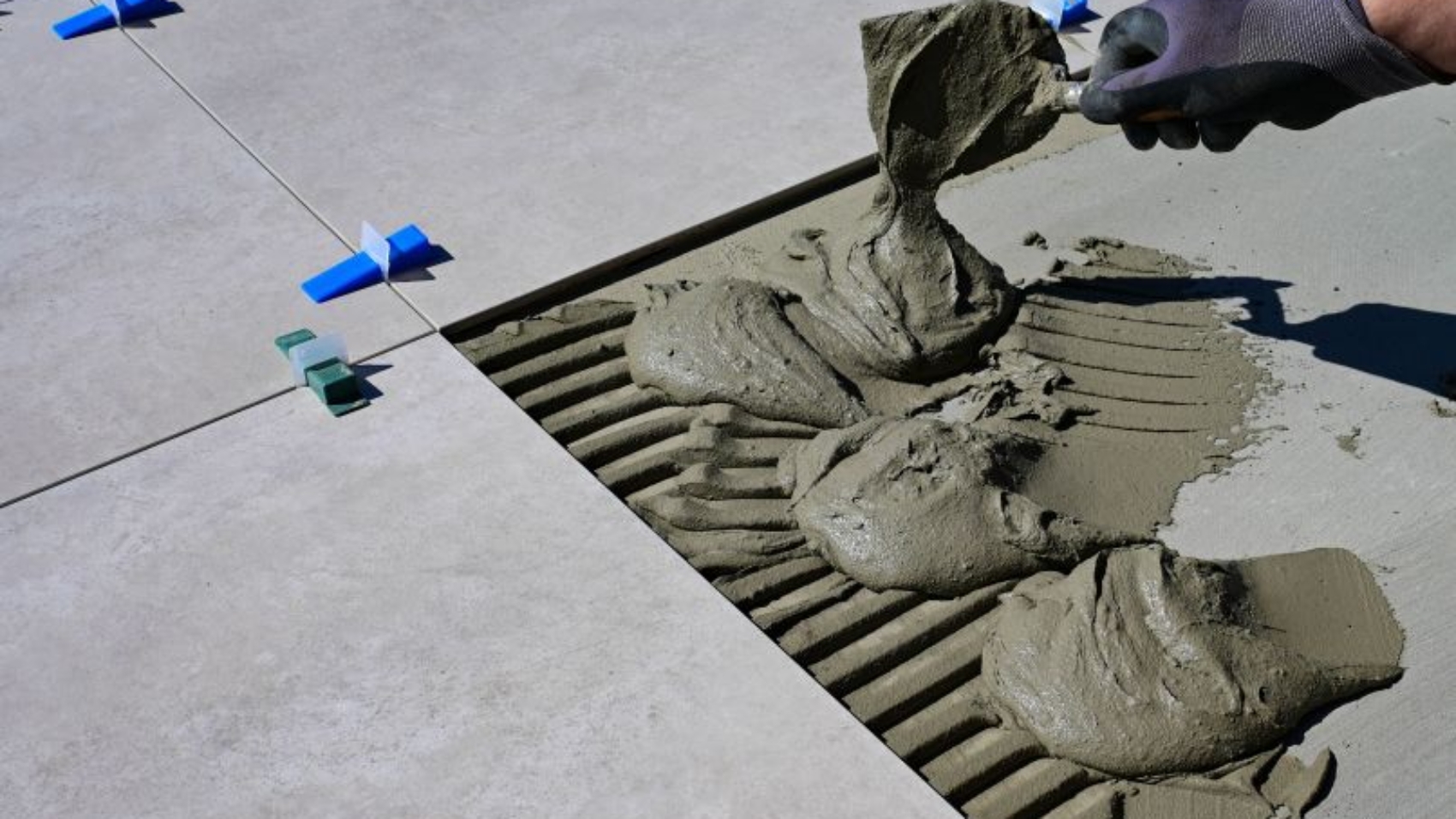
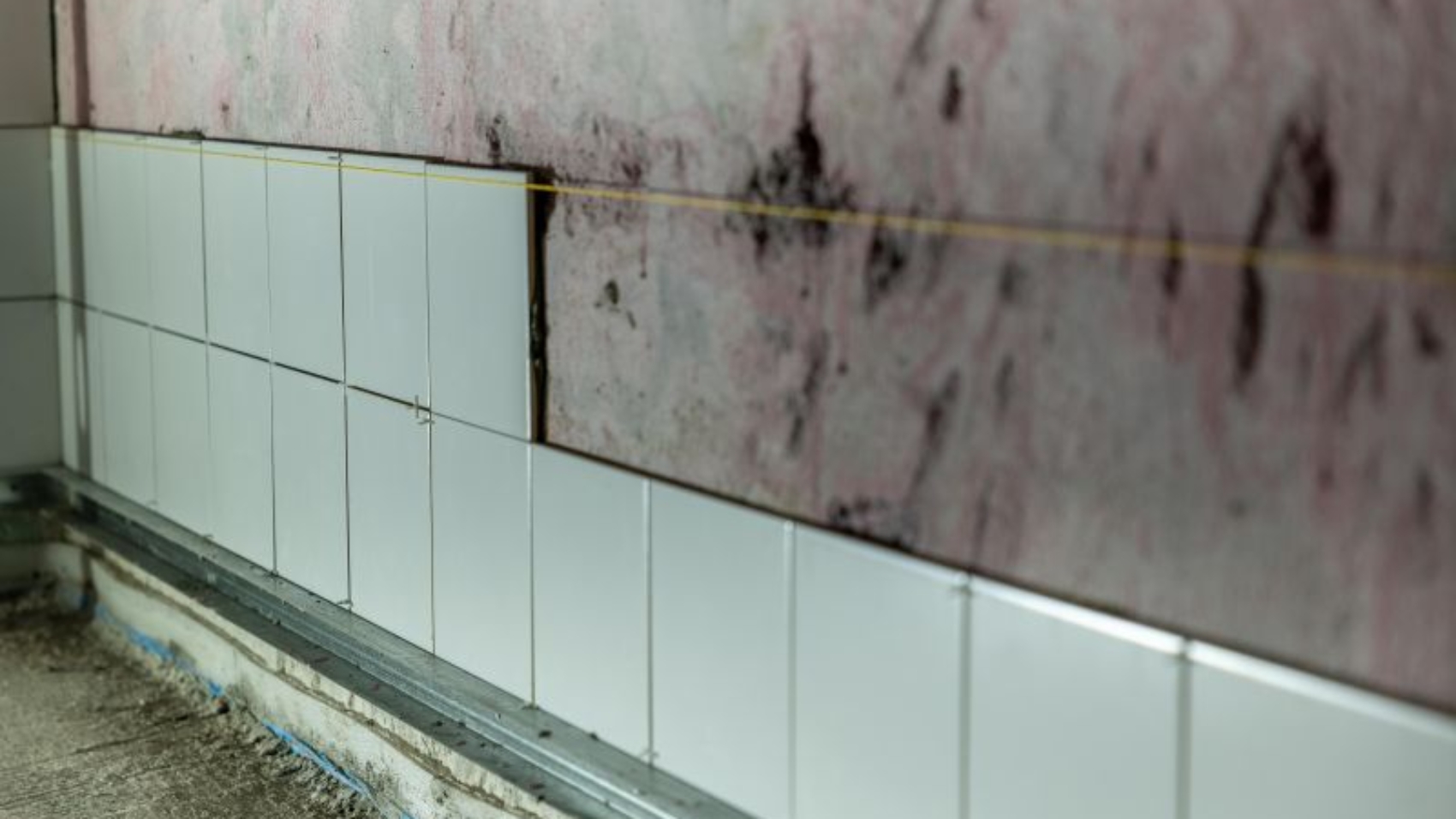
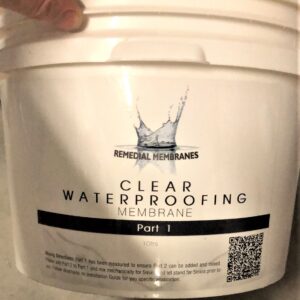
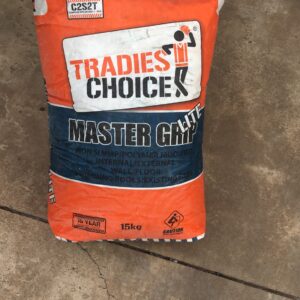
Waterproofing on top of tiles - Itile Bathrooms NTTradies-Choice-WPM-Glue-for-setting-tile-Itile-Bathrooms-NT

What AS 3740:2021 Actually Covers

AS 3740:2021 waterproofing of domestic wet areas is the current Australian Standard setting out minimum requirements for the materials, design and installation of waterproofing in Class 1 (houses), Class 2 (units and apartments) and Class 4 residential buildings. It is referenced by the National Construction Code (NCC), making it an important standard for meeting waterproofing requirements in domestic wet areas. The exact requirements that apply can depend on the type of building and the work being carried out.

The 2021 edition reorganised the standard into sections covering scope and definitions, design principles, acceptable materials, and installation details for showers, baths, junctions and penetrations. One of its more useful features for homeowners is that it classifies wet area surfaces by risk:

  • High-risk areas — shower floors and walls within the shower recess, and any floor with a floor waste.
  • Medium-risk areas — floors outside the shower but still within the wet area, such as around a bath or vanity.
  • Low-risk areas — walls outside the shower that aren’t likely to see direct water contact.

Higher-risk areas require full membrane waterproofing, while lower-risk areas may only need a water-resistant (rather than fully waterproof) treatment. This is why your shower recess may be waterproofed differently from other parts of the bathroom. It doesn’t necessarily mean corners are being cut — different areas have different levels of exposure to water.

Which Parts of a Bathroom Need Waterproofing

As a general rule, expect waterproofing to cover:

  • The entire shower floor and walls to at least 1800 mm above the floor (higher for hobless or step-free showers)
  • Floor junctions where walls meet the floor
  • Around floor wastes, pipe penetrations and hobs
  • The floor beneath baths and vanities
  • Any timber or particleboard flooring in the wet area, which needs full waterproofing rather than just a water-resistant coating

How the Work Is Actually Carried Out

Waterproofing isn’t just about putting a membrane on the floor. There’s a process to follow, and problems can start when one of those steps is rushed or missed.

  1. Preparation — removing old tiles and membrane, checking the substrate (the base layer, whether concrete, fibre-cement sheeting or timber) is sound, clean and structurally adequate.
  2. Falls and drainage — the floor needs correct fall toward the floor waste before membrane goes down, so water drains rather than pools.
  3. Priming — a bonding primer is applied so the membrane adheres properly.
  4. Membrane application — usually two or more coats, with a fabric reinforcing strip embedded at joints, corners and penetrations where cracking is most likely.
  5. Curing — the membrane needs time to cure fully before tiling starts. Rushing this step is a common source of early failures.
  6. Inspection — ideally by an independent party or the certifying tradesperson, before tiles go down and the membrane is covered forever.
  7. Tiling and finishing — once the membrane has passed inspection.

How to Waterproof a Shower (and Shower Base)

The shower is the highest-risk part of any bathroom. It gets the most water, the most movement and the most penetrations. Shower waterproofing follows the general process above, with extra detail at these points:

  1. Falls to the waste. The shower floor is screeded (or a preformed base is installed) so water drains to the waste with no ponding.
  2. Puddle flange at the floor waste. A waste flange is installed and bonded into the membrane so water under the tiles can still drain away.
  3. Reinforced junctions. Wall-to-floor and wall-to-wall corners get bond breakers or reinforcing so the membrane can flex rather than tear.
  4. Sealed penetrations. The mixer, shower rose and any niche are sealed with collars or flanges compatible with the membrane.
  5. Floor and walls coated. The whole shower floor and the walls to at least 1800 mm high get two or more coats, each laid at right angles to the last, to the specified thickness.
  6. Edge of the shower. A hob, step-down or waterstop angle stops water travelling under the tiles into the rest of the room.
  7. Cure, inspect, photograph. Only then does tiling start.

Shower bases, hobless and walk-in showers

Hobless and walk-in showers look great, but there’s no hob to contain water, so the falls, waterstop and floor waterproofing have to be spot on. Often more of the bathroom floor is waterproofed to allow for it. Linear (strip) drains need their own flange detail. A preformed shower base still needs correct membrane detailing where it meets the walls and floor; the base alone doesn’t waterproof the shower.

Waterproofing a Bathroom Floor Before Tiling

  • Get the falls right first. Fix any ponding in the screed before the membrane goes down, not after.
  • Prepare the substrate. It should be sound, clean and dry. Any timber or particleboard floor in the wet area needs full membrane coverage.
  • Follow the system’s build-up. Some systems put the membrane under the screed, others on top. Either way, the floor waste must be detailed so water can drain.
  • Run the membrane up the walls at the wall/floor junction (the skirting zone), with the junction reinforced.
  • Choose a compatible tile adhesive and don’t tile until the membrane has fully cured.
  • Waterproof the whole floor if you can. Even where the floor outside the shower only needs to be water-resistant, many Darwin homeowners choose full-floor waterproofing for extra protection.

Common Mistakes That Lead to Leaks

  • Insufficient membrane thickness or missed coats, often from trying to save time or material.
  • Skipping the reinforcing strip at corners, junctions and around the floor waste — these are the highest-movement points in the room.
  • Tiling before the membrane has cured, which can trap moisture or damage the membrane itself.
  • Poor floor falls, leaving water pooling instead of draining.
  • Cutting corners on penetrations — pipes, tap fittings and hob junctions are where most real-world leaks originate.
  • No inspection before covering the membrane, meaning defects go unnoticed until the tiles are already laid.
  • Mixing products from different systems (primer from one brand, membrane from another), which can cause adhesion problems and void warranties.
  • Other trades drilling or fixing through the finished membrane for vanities, toilet pans or shower screens without sealing the fixings.

Warning Signs Your Bathroom May Have a Waterproofing Problem

  • Tiles that feel loose, hollow-sounding, or are lifting at the edges
  • Discoloured or bubbling paint on a wall that backs onto the bathroom
  • A persistent musty smell that doesn’t clear with ventilation
  • Visible mould at skirting boards, cornices or ceilings below the bathroom
  • Soft or spongy flooring near the shower or toilet
  • Water stains on a ceiling in the room below an upstairs bathroom

Any one of these on its own isn’t necessarily a disaster, but they’re worth investigating before they become a bigger repair.

Waterproofing Certificates and Documentation in the NT

Keeping records of bathroom renovation and waterproofing work can be useful, particularly if you sell the property later. Depending on the work involved, you may need relevant compliance documentation, inspection records or certificates from the licensed professionals involved.

Ask your builder or waterproofing professional what documentation will be provided before the work starts. It’s also worth keeping photos of the membrane before it is covered by tiles, along with any relevant certificates and inspection records.

Bathroom Waterproofing Cost in Darwin

Bathroom waterproofing Darwin cost is one of the first things people ask about, but there isn’t one fixed price. The final cost depends on the size of the bathroom, the condition of the existing surfaces and how much work is involved.

As a rough guide, waterproofing on its own — including labour and materials for a standard bathroom floor and shower recess — can cost into the low thousands. A complete bathroom renovation in Darwin will cost more once you factor in waterproofing, demolition, tiling, plumbing, electrical work, fixtures and installation.

What can affect the price?

  • The size of the bathroom and the amount of floor and wall area requiring waterproofing
  • Whether the existing tiles, membrane or substrate need to be removed
  • Whether the bathroom layout is changing, such as moving a shower or adding a new fixture
  • The condition of the plumbing, walls and flooring once the existing bathroom is opened up
  • The choice of tiles, vanity, shower screen, bathroom suite and other fittings
  • Whether building permits or other professional services are required

For homeowners looking at a complete renovation rather than waterproofing alone, Itile Bathrooms NT offers bathroom renovation packages from $22,000*, with services that can include project management, demolition, tiling, waterproofing, plumbing, electrical and carpentry. Depending on the project, this can also extend to items such as shower screens, bathroom suites, vanities, stone benchtops and permit-related work.

The important thing is to treat any advertised starting price as a guide, rather than a quote for your particular bathroom. An accurate figure comes from looking at the existing space, understanding what needs to change and working through the finishes and services you want included.

*Starting price subject to project scope and inclusions. Confirm current pricing and inclusions with Itile Bathrooms NT.

Do I Need a Building Permit to Renovate My Bathroom in the NT?

This depends entirely on the scope of the work, and it’s worth confirming directly with the Director of Building Control or a registered building certifier before you start, because the rules distinguish between several categories of work.

Generally, in NT building control areas (which include Darwin):

  • Minor, like-for-like work — replacing a bath, basin, tapware or shower screen, or retiling a small damaged area without touching the membrane — usually doesn’t require a building permit.
  • Plumbing work that doesn’t change the layout — such as replacing existing water services with no new penetrations — may only need a Certificate of Compliance from a licensed plumber, without a full building permit.
  • Work that changes the structure or layout — putting in or removing a wall, breaking into walls or floors in the wet area, or installing a new fixture where one didn’t exist before (say, adding a shower where there was only a bath) — generally does require a building permit and certification from an NT-registered building certifier.

Because the classification affects whether you need a certifier, a building contract, and possibly livable housing design compliance, it’s genuinely worth a quick call to NT Building Advisory Services (08 8999 8985) or your certifier before finalising your renovation plans, rather than assuming based on a similar job someone else did.

What to Ask Your Builder or Waterproofer Before Work Begins

  • Which waterproofing system will be used, and is it compliant with AS 3740:2021?
  • Will the membrane be independently inspected before tiling covers it?
  • Will I receive a compliance certificate and photos of the completed membrane?
  • Is a building permit required for this scope of work, and who’s arranging it?
  • What’s the expected curing time before tiling starts?
  • How are penetrations, hobs and floor wastes being treated?

A Practical Checklist for Checking Waterproofing Work

  • ✅ Membrane covers the full shower recess and extends to the required height on walls
  • ✅ Reinforcing strips are visible at corners, junctions and penetrations before tiling
  • ✅ Floor has a clear, correct fall toward the floor waste
  • ✅ Adequate curing time was allowed before tiling began
  • ✅ You’ve received (or will receive) a compliance certificate and inspection photos
  • ✅ Any timber flooring in the wet area has full membrane coverage, not just a surface coating

FAQs

Are tiles waterproof? 

No. Tiles and grout resist water, but grout is porous and joints crack over time. A membrane under the tiles does the waterproofing.

What’s the best waterproofing membrane for a shower? 

It depends on the substrate, the shower design and the tiles. Most Darwin showers use a flexible, liquid-applied membrane as part of one manufacturer’s complete system, installed by a professional who can certify it to AS 3740.

How high should shower waterproofing go? 

The whole shower floor and the shower walls to at least 1800 mm above the floor. Hobless and walk-in designs usually need more of the floor waterproofed too.

Can you waterproof over existing tiles? 

Clear sealers can be applied over tiles and grout to treat minor leaks, but they don’t replace a membrane under the tiles. See Only One Bathroom and the Waterproofing Has Failed? for repair options.

Is AS 3740:2021 the current standard for bathroom waterproofing in Australia? 

Yes. AS 3740:2021 is the current edition covering waterproofing of domestic wet areas. It replaced the 2010 edition. 

Can I waterproof my own bathroom in the NT? 

You can buy waterproofing products, but DIY rarely pays off. The work has to meet AS 3740, and anything involving floor wastes or fixtures needs a licensed plumber. Without a compliance certificate from a qualified installer, you may also run into trouble with insurance claims, building certification or selling the home later.

How long does bathroom waterproofing take? 

The application itself typically takes one to two days, but allow several more for curing before tiling starts — rushing this step is a common cause of failure.

Does Darwin’s climate make waterproofing more important? 

Darwin’s humidity and wet season mean moisture problems can develop and spread quickly if a membrane fails, which is a good reason to prioritise proper installation and documentation rather than assume the climate itself changes the technical requirements.

What’s the difference between water-resistant and waterproof? 

Waterproof means no water can pass through under normal conditions; water-resistant materials can withstand occasional moisture but aren’t designed to hold back sustained water contact, which is why high-risk areas like shower floors always need full waterproofing rather than a water-resistant finish.

Getting It Right the First Time

Waterproofing is the one part of a bathroom renovation you genuinely can’t see or fix cheaply once the tiles are down, which is exactly why it’s worth spending time on the details — the right membrane, proper curing, an inspection before covering it, and paperwork to prove it was done to standard.

If you’re planning a Darwin bathroom renovation and want a proper assessment of what your project involves — including waterproofing, permits and realistic costs — Itile Bathrooms NT can walk you through it based on your specific bathroom rather than a generic checklist. You can reach them on 0400 729 303 or get in touch here.

shower glass restoration

Shower Glass Restoration in Darwin: How to Bring Cloudy Shower Screens Back to Life

Restore the Clarity and Beauty of Your Shower Glass Without Replacing the Entire Screen

A cloudy shower screen can quickly make an otherwise beautiful bathroom look old, tired, and poorly maintained. Many homeowners and property managers in Darwin, NT notice their shower glass becoming dull, stained, or covered with stubborn marks over time — especially with the region’s tropical climate, humidity, mineral-rich water, and frequent use.

The good news is that cloudy shower glass does not always need to be replaced. With the right techniques, damaged-looking glass can often be restored, improving the appearance of your bathroom while extending the life of your existing shower screens.

Whether you own a residential property, manage a hotel, operate a gym, or look after commercial facilities, shower glass restoration can be a practical way to maintain clean, modern, and inviting bathrooms.

What Is Shower Glass Restoration?

Shower glass restoration is the process of professionally removing stains, mineral deposits, soap scum build-up, and surface damage from shower screens to restore their original clarity and appearance.

Unlike basic cleaning, restoration focuses on treating the glass surface itself. Over time, shower glass can develop layers of calcium deposits, water marks, and chemical residue that standard household cleaners cannot remove.

A proper restoration process may include:

  • Deep cleaning to remove built-up contaminants
  • Polishing to improve glass clarity
  • Removing mineral deposits and water stains
  • Treating surface imperfections
  • Applying protective coatings to help prevent future build-up

Many property owners search for a shower glass restoration kit hoping to fix cloudy glass themselves. Still, professional restoration usually achieves longer-lasting results because specialists use commercial-grade techniques and understand how different types of glass respond to treatment.

Why Does Shower Glass Become Cloudy or Stained?

Cloudy shower glass is one of the most common bathroom maintenance issues in Darwin. Several factors contribute to the problem:

Hard Water and Mineral Deposits

When water dries on glass, minerals such as calcium and magnesium can remain behind. Over time, these deposits create a cloudy, white appearance that becomes harder to remove.

Soap Scum and Product Build-Up

Body washes, shampoos, conditioners, and cleaning products can leave behind residue that sticks to the glass surface.

Humidity and Darwin’s Tropical Climate

Darwin’s warm, humid conditions can accelerate moisture-related issues. Without proper ventilation and regular care, shower screens may develop more noticeable staining.

Incorrect Cleaning Products

Some harsh chemicals can damage protective coatings or contribute to surface etching, making the glass look permanently dull.

Understanding the cause of the problem is important because the right treatment depends on whether the glass is stained, etched, scratched, or simply covered in residue.

Signs Your Shower Glass Needs Restoration

Not sure whether your shower screen needs professional attention? Look for these signs:

  • The glass looks cloudy even after cleaning
  • White mineral marks keep returning
  • Water spots have become permanent
  • The surface feels rough or uneven
  • The bathroom looks outdated despite renovations
  • Cleaning takes longer but produces little improvement
  • Glass appears dull compared with new shower screens

If you notice these issues, searching for shower glass restoration near me can help you find local professionals who understand the environmental conditions affecting Darwin bathrooms.

Restoration vs Replacement: Which Is More Cost-Effective?

One of the biggest questions homeowners and businesses ask is whether they should restore their shower glass or replace it completely.

In many cases, restoration is the more economical choice.

Replacement may involve:

  • Removing existing shower screens
  • Purchasing new glass
  • Installation costs
  • Additional bathroom repairs
  • Longer disruption

Restoration allows you to keep your existing shower structure while improving its appearance.

The final shower glass restoration cost depends on factors such as:

  • Size of the shower screen
  • Level of staining or damage
  • Type of glass
  • Amount of labour required
  • Whether protective treatments are added

For many Darwin properties, restoring quality shower glass provides excellent value compared with a full replacement.

Benefits of Professional Shower Glass Restoration

shower glass restoration

Professional restoration offers several advantages for both homes and commercial properties.

Improved Bathroom Appearance

Clear shower glass instantly makes a bathroom feel cleaner, brighter, and more modern. This is particularly valuable for hotels, resorts, rental properties, and commercial facilities where presentation matters.

Longer Glass Lifespan

Regular professional care helps protect shower screens from ongoing damage caused by mineral build-up and environmental factors.

Better Hygiene and Maintenance

Clean glass surfaces are easier to maintain. Professional treatments can reduce the amount of residue that sticks to the screen.

Cost Savings Over Time

Instead of replacing shower screens prematurely, restoration helps maximise the value of your existing bathroom investment.

Some homeowners compare options like shower glass restoration brisbane, but local Darwin expertise is important because the climate, water conditions, and property needs can vary significantly between regions.

Why Professional Restoration Beats DIY Methods

DIY cleaning methods can sometimes improve surface marks, but they often cannot address deeper issues such as mineral bonding or glass etching.

Many online recommendations involve household acids, abrasive tools, or untested shower glass restoration products that may create more damage if used incorrectly.

Professional restoration delivers better results because specialists:

  • Identify the cause of the damage
  • Use suitable restoration methods
  • Protect the glass surface
  • Achieve a consistent finish
  • Reduce the risk of further damage

A trained technician can determine whether your shower glass can be restored or whether replacement is genuinely required.

Keeping Shower Glass Looking New After Restoration

After restoration, simple maintenance can help preserve your shower screens.

Follow these tips:

  • Use a shower squeegee after each use
  • Keep the bathroom well ventilated
  • Avoid harsh abrasive cleaners
  • Wipe away water droplets regularly
  • Use gentle cleaning solutions
  • Schedule professional maintenance when needed

For hotels, gyms, and commercial bathrooms, regular professional shower glass cleaning can help maintain a consistently high standard for customers, visitors, and staff.

A planned shower glass cleaning service can also reduce long-term maintenance issues by preventing heavy build-up before it becomes difficult to remove.

How Restored Shower Glass Adds Value to Your Property

Bathrooms are one of the most important areas buyers, tenants, and guests evaluate. A clean, modern bathroom can influence how people perceive the entire property.

Restored shower glass helps:

  • Create a fresher bathroom appearance
  • Improve overall property presentation
  • Support higher rental appeal
  • Enhance guest experiences
  • Maintain a professional image for commercial spaces

For Darwin homeowners and businesses, maintaining quality bathroom finishes is a practical investment.

Why Darwin Residents Trust Itile Bathrooms NT

When it comes to bathroom improvements, choosing an experienced local team makes a difference. Itile Bathrooms NT understands the unique challenges Darwin properties face, including humidity, tropical weather conditions, and the demands placed on residential and commercial bathrooms.

With extensive bathroom renovation experience, Itile Bathrooms NT delivers high-quality workmanship, careful attention to detail, and reliable customer service from start to finish.

The team provides tailored solutions for:

  • Residential bathroom renovations
  • Commercial bathroom upgrades
  • Property maintenance improvements
  • Shower screen improvements
  • Bathroom transformations

Their knowledge of Darwin’s climate and property requirements helps ensure every project is completed with practical, long-lasting results.

Whether you are refreshing a family bathroom, preparing a rental property, or upgrading facilities for a business, Itile Bathrooms NT focuses on delivering results that look great and perform well.

Frequently Asked Questions About Shower Glass Restoration

Can cloudy shower glass be restored?

Yes. Many cloudy shower screens can be restored by removing mineral deposits, stains, and surface build-up. However, severely etched glass may require replacement.

How long does shower glass restoration take?

The timeframe depends on the condition and size of the glass. Minor restoration may be completed quickly, while heavily stained screens require more detailed treatment.

Is shower glass restoration cheaper than replacement?

In many situations, restoration is more affordable because it avoids the cost of new glass and installation.

Can I restore shower glass myself?

DIY products may help with light marks, but professional restoration is safer and more effective for deep staining or mineral damage.

How can I prevent shower glass from becoming cloudy again?

Regular cleaning, drying the glass after use, and professional maintenance can help prevent future build-up.

Bring Your Shower Glass Back to Life in Darwin

Cloudy shower screens do not have to make your bathroom look outdated. With professional shower glass restoration, you can improve clarity, protect your investment, and create a cleaner, more attractive space.

Whether you are a homeowner, property manager, hotel operator, or commercial facility owner in Darwin, NT, Itile Bathrooms NT can help restore and upgrade your bathroom with expert solutions.

Contact Itile Bathrooms NT today to request a consultation or quote.

Phone: +61 400 729 303
Contact page: https://itilebathroomsnt.com/contact/

Restore your shower glass, refresh your bathroom, and experience the difference professional workmanship can make.